
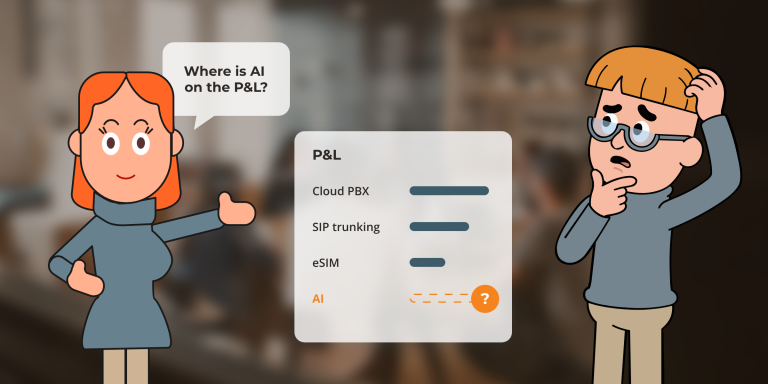
Large operators report big AI “value”. Their filings show smaller numbers. Here’s where AI reaches the profit and loss (P&L), and how a smaller operator can make sure its AI does too.
Picture a cloud PBX provider with a few hundred business customers. A dental clinic on its platform sees that a competing PBX provider’s website says “AI-powered” and asks whether its phones could answer patients and book appointments. The provider switches on an AI agent for the clinic, with no clear view of what it costs or earns. Then, at the monthly review, finance asks one question: “Where is AI on the P&L?”
That question is hard to answer, even for the largest operators. PortaOne went through 2026 filings and investor calls from large operators to see what they report. This post covers what the numbers show, why most AI “value” never reaches the income statement, and three ways an operator can put AI on the invoice, with PortaOne’s billing as the worked example.
Large operators’ AI revenue is 0.2% to 3.1% of the total
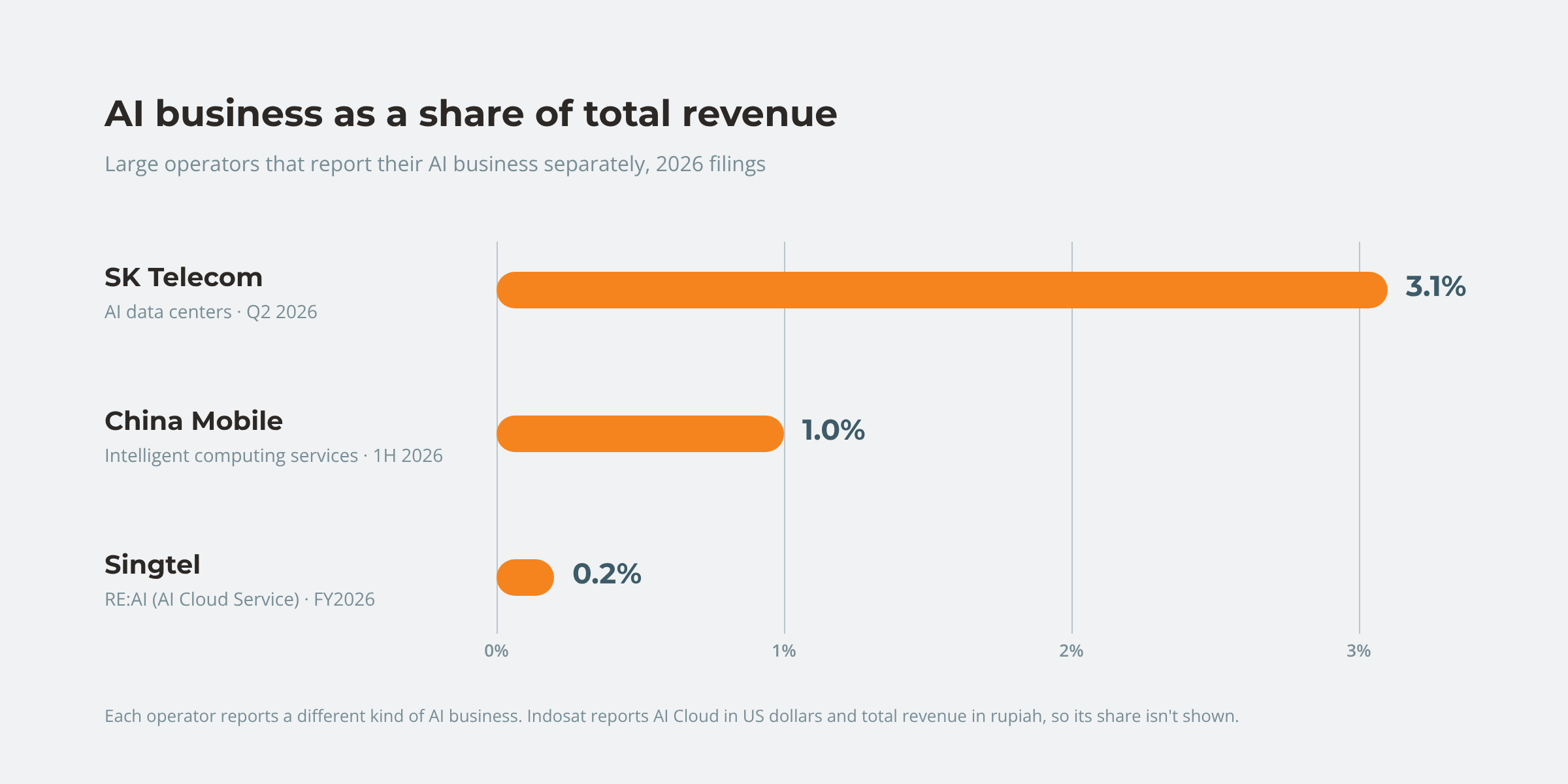
Some large operators now report revenue from specific AI businesses, such as AI data centers or AI cloud. That makes their filings a fair benchmark. The last column shows what share of the operator’s total revenue that AI business brings in.
| Operator | AI business in the filing | Period | AI revenue | Share of total revenue |
|---|---|---|---|---|
| SK Telecom | AI data centers | Q2 2026 | KRW 136.2B | 3.1% |
| China Mobile | Intelligent computing services | 1H 2026 | RMB 5.3B | 1.0% |
| Singtel | RE:AI (AI Cloud Service) | FY2026 | S$25M | 0.2% |
| Indosat Ooredoo Hutchison | AI Cloud | 1H 2026 | US$33M | Not given (see below) |
The growth is real: SK Telecom’s AI data center revenue rose 92.5% in a year, and China Mobile’s intelligent computing services rose 130.1%. Still, for the three operators whose share can be calculated, these AI businesses bring in 0.2% to 3.1% of total revenue.
Indosat reports AI Cloud in US dollars and total revenue in rupiah, and its release gives no exchange rate. It reports growth instead: US$33M in the first half of 2026, more than the US$28M for all of 2025.
Each operator reports a different kind of AI business, so the figures are not a like-for-like comparison. They show how big these businesses are today.
The biggest AI numbers are forecasts, deals, and mixed savings
The larger AI figures in operator news come from other places:
- T-Mobile US said on its February 2026 investor call that AI and digital initiatives would deliver $1.3B of incremental savings in 2026 and $2.7B in 2027, relative to 2025. That’s a forecast that counts AI and digital work together.
- Verizon signed a deal with Google “in excess of $1 billion”. Verizon calls it a long-term deal and expects its AI Connect business to be “meaningful in our results in 2027”.
- AT&T reports “over $1 billion of cost savings” in 2025. Its annual report doesn’t say how much of that came from AI.
These figures are accurate, but they measure different things. None of them is AI revenue or AI savings booked this year, yet added together they sound much bigger than anything in this year’s income statement.
Why AI value gets lost before it reaches the P&L
The gap isn’t only a telecom problem. In PwC’s 2026 CEO Survey, 56% of CEOs said AI had brought them neither higher revenue nor lower costs, and 22% said AI had raised their costs. McKinsey’s 2026 survey shows the same gap from another perspective: 80% of respondents say AI has improved their own productivity, but only 37% attribute any EBIT impact to AI.
For a telecom operator, four things explain most of the gap.
The price of inference keeps falling
Epoch AI measured how fast the price of reaching a given level of AI performance falls: between 9× and 900× a year, depending on the task. The fastest drops came in the most recent year, though Epoch notes it’s less clear how long they will last. Even at the slow end of that range, anyone who sells inference sells something that keeps getting cheaper. Revenue grows only if volume grows faster than the price falls, and margin holds only if the operator knows the cost and the price of each request.
Saved time turns into money in only two cases
An AI agent that answers a question in 2 minutes instead of 10 saves 8 minutes. That time becomes money only if the operator needs fewer paid hours, or sells the service to someone. If neither happens, the saving stays on a slide.
AI brings its own bill
AI running costs are real. In McKinsey’s survey, about 20% of respondents say AI operating costs, including token costs, held back their AI use. If an AI feature has no price for the customer, the operator carries that cost and nothing comes back on the invoice.
Free AI bundles bring downloads, and no telco revenue figures yet
Airtel offered its 360 million customers a free year of Perplexity Pro. According to Sensor Tower estimates reported by TechCrunch:
- Perplexity got 56 million downloads in India while the offer was open.
- When new sign-ups stopped, downloads fell by more than 90%.
- Perplexity’s in-app and subscription revenue in India still rose about 60%. TechCrunch notes that this doesn’t show Airtel users are the ones paying.
So far, the reported numbers are Perplexity’s. The article gives none for Airtel, so whether the bundle created lasting value for subscribers or revenue for the operator is still an open question.
AI makes money when it’s a service a customer pays for
Look again at the operators with a real AI revenue line. SK Telecom delivers AI data center infrastructure to customers such as global Big Tech companies. China Mobile sells intelligent computing services. Singtel sells RE:AI, its AI Cloud Service, and Indosat sells AI Cloud. In each case, AI is a service a customer pays for.
PwC’s cross-industry data points the same way. The 12% of CEOs who saw both more revenue and lower costs from AI have applied AI to their products, services, and experiences far more often than other companies: 44% versus 17%.
That gives a practical rule:
- AI makes money when it’s a line on the customer’s invoice, and the operator knows what it costs.
- AI saves money when the operator can count the work it did, and spends less on that work.
There are three ways to put that rule to work, depending on which AI business an operator is in.
Path 1: You sell AI capacity
This is what the operators in the table do: AI data centers, AI cloud, and AI computing. Smaller GPU clouds and inference providers have the same billing job, and it changes when they move from renting GPU hours to selling tokens.
Renting a GPU by the hour needs little billing. Selling per-token endpoints to many customers brings new problems:
- A long response runs a prepaid balance past zero, because tokens are counted after the response.
- Each new model adds new units to the price list: cached tokens, reasoning tokens, audio seconds, and tool calls.
- Customers want GPU hours and tokens on one invoice.
- Resellers in neighboring markets need their own settlement.
Prepaid is common in this market: 118 of the 156 AI platforms PortaOne reviewed sell mainly on prepaid credits or a wallet. On a prepaid plan, usage can run past zero before anyone has paid for it.
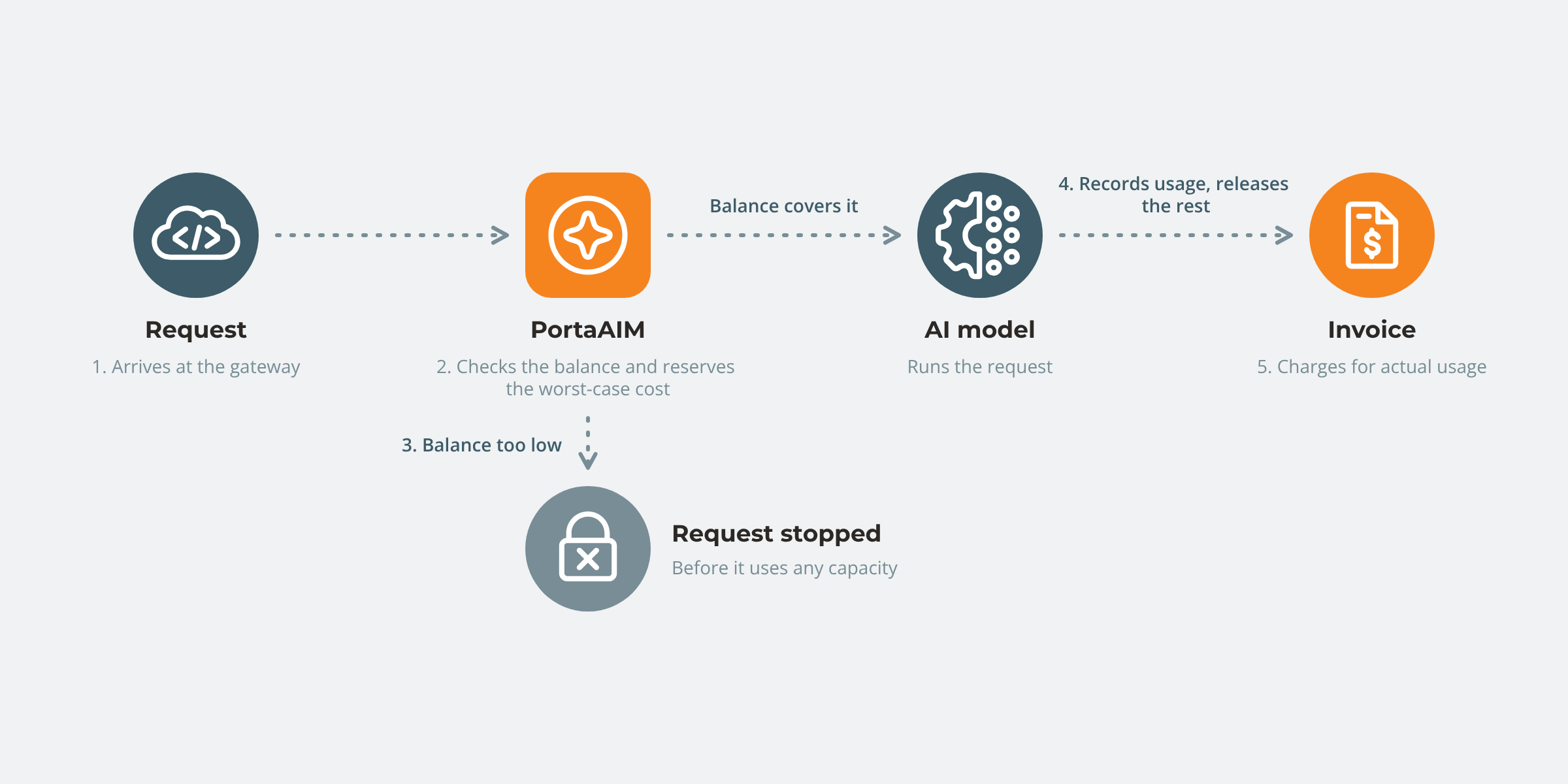
Here’s how PortaAIM handles a request. PortaAIM sits in the request path, between the AI gateway and the model:
- A request arrives at the gateway.
- PortaAIM checks the balance before the request runs. It knows the model and the maximum response size, so it reserves the worst-case cost.
- If the balance can’t cover it, PortaAIM stops the request before it runs.
- PortaAIM records the actual usage in tokens, images, audio, tool calls, or other units, and releases the part of the reservation that wasn’t used.
- The charge goes on the customer’s invoice. In PortaAIM, one customer account can carry a per-hour GPU charge and per-token charges, taken from one balance and shown on one invoice.
Resellers are settled with PortaBilling’s reseller features.
Two things matter when prices keep falling:
- Margin: PortaAIM shows usage, charges, and costs for every request, and revenue, cost, and margin per call.
- Cost: PortaAIM can route each request to the lowest-cost model that still meets your quality and provider requirements.
PortaAIM runs on the operator’s own infrastructure, in-country if needed, or hosted by PortaOne. PortaAIM is in pilots with early sovereign AI and GPU cloud operators. To see it on your own pricing, start with a technical call about your case: talk to the PortaAIM team.
Path 2: You resell AI services to business customers
Most cloud PBX and SIP trunking providers won’t build an AI data center. They can still put AI on the invoice. Here’s how a call to an AI agent works in PortaBilling:
- A caller dials the business customer’s number, and the auto-attendant sends the call to the extension where the AI voice agent works.
- PortaBilling rates the call on both sides. A customer tariff sets the operator’s price for calls to AI agents, and a vendor tariff records what those calls cost the operator.
- The operator bills AI agent calls with their own charge, alongside its existing voice services. Because PortaBilling records both the price and the cost, the operator can compare them.
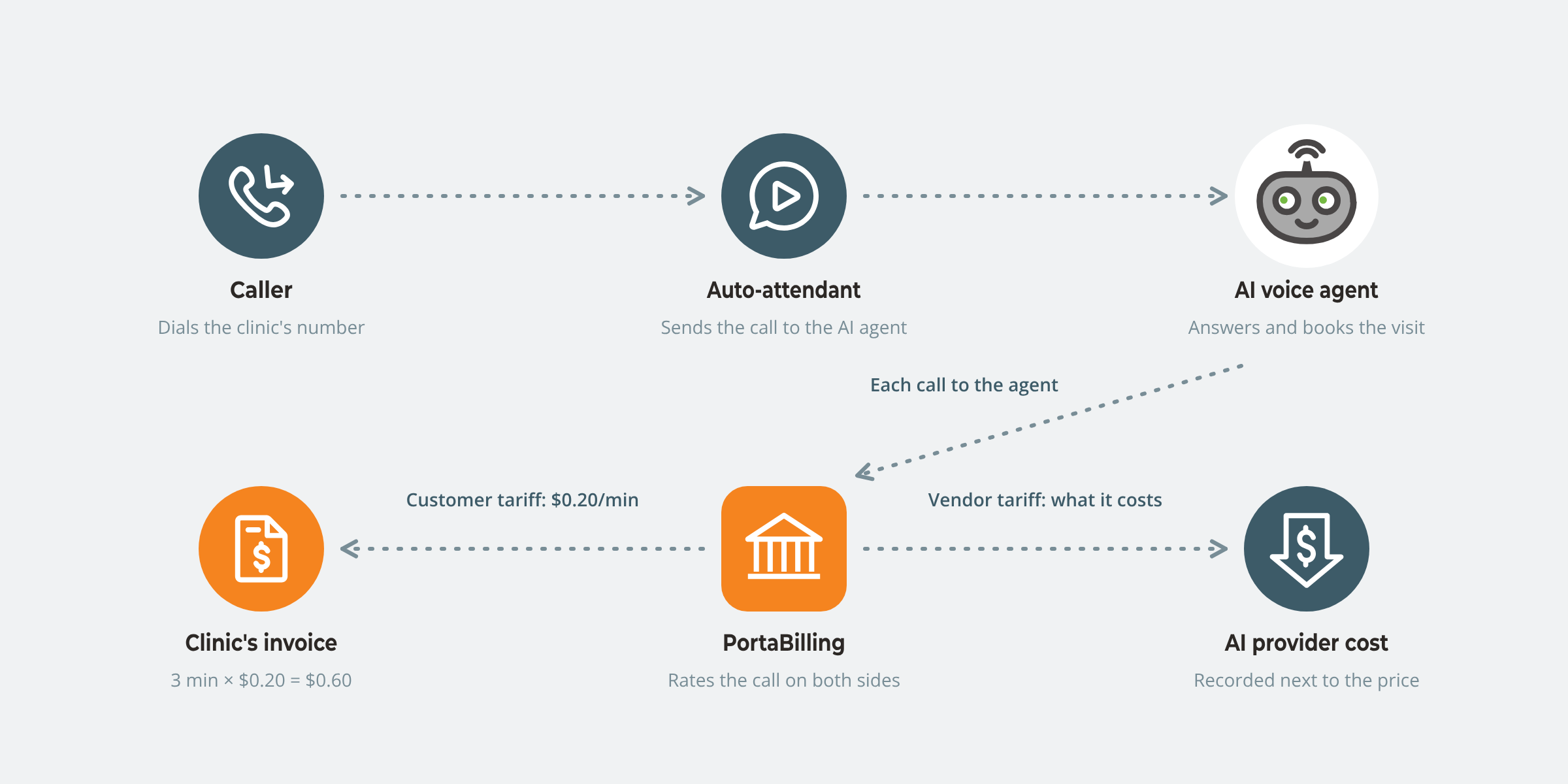
In PortaOne’s documentation example, a cloud PBX provider charges $0.20 per minute for calls to AI agents. Its customer, a dental clinic, uses an AI agent to answer questions and book appointments. A caller talks to the agent for 3 minutes, and the provider charges the clinic $0.60 for that call. The provider sets its own markup on top of the AI provider’s wholesale price, and can charge per minute or include the service in a subscription plan.
The same approach works for call recording and transcription. PortaOne’s documentation example is a $10 monthly bundle with 10 hours of call recording and 10 hours of transcription, then $0.03 per minute for recording and $0.05 per minute for transcription. Text-to-speech covers a third case: IVR messages that depend on information only available at call time, such as the caller’s name, appointment details, or a verification code.
All three services are modules in the PortaOne Add-on Mart: Voice AI Agent (Apifonica), Speech-to-Text (Whisper) for call and voicemail transcription, and Text-to-Speech (ElevenLabs). To see what AI voice traffic could bring in, try PortaOne’s revenue calculator.
These prices are examples from PortaOne’s documentation, not customer results. For the pricing side, see Your AI Cost Problem: AI Margins Live Between Two Invoices and Why Voice AI Cost Per Customer Is Still a Mystery to Operators.
Path 3: You use AI internally
Savings need the same accounting. If an AI agent does work for the support team or for resellers, the operator should be able to see that work.
With the PortaBilling MCP Server, an operator connects the AI it already uses to PortaBilling:
- PortaOne recommends one PortaBilling user per agent, with its own username, password, role, and access controls.
- Every change the agent makes is recorded in the PortaBilling audit log under the agent’s own identity.
- PortaOne hosts and maintains the MCP server, as a module in the Add-on Mart.
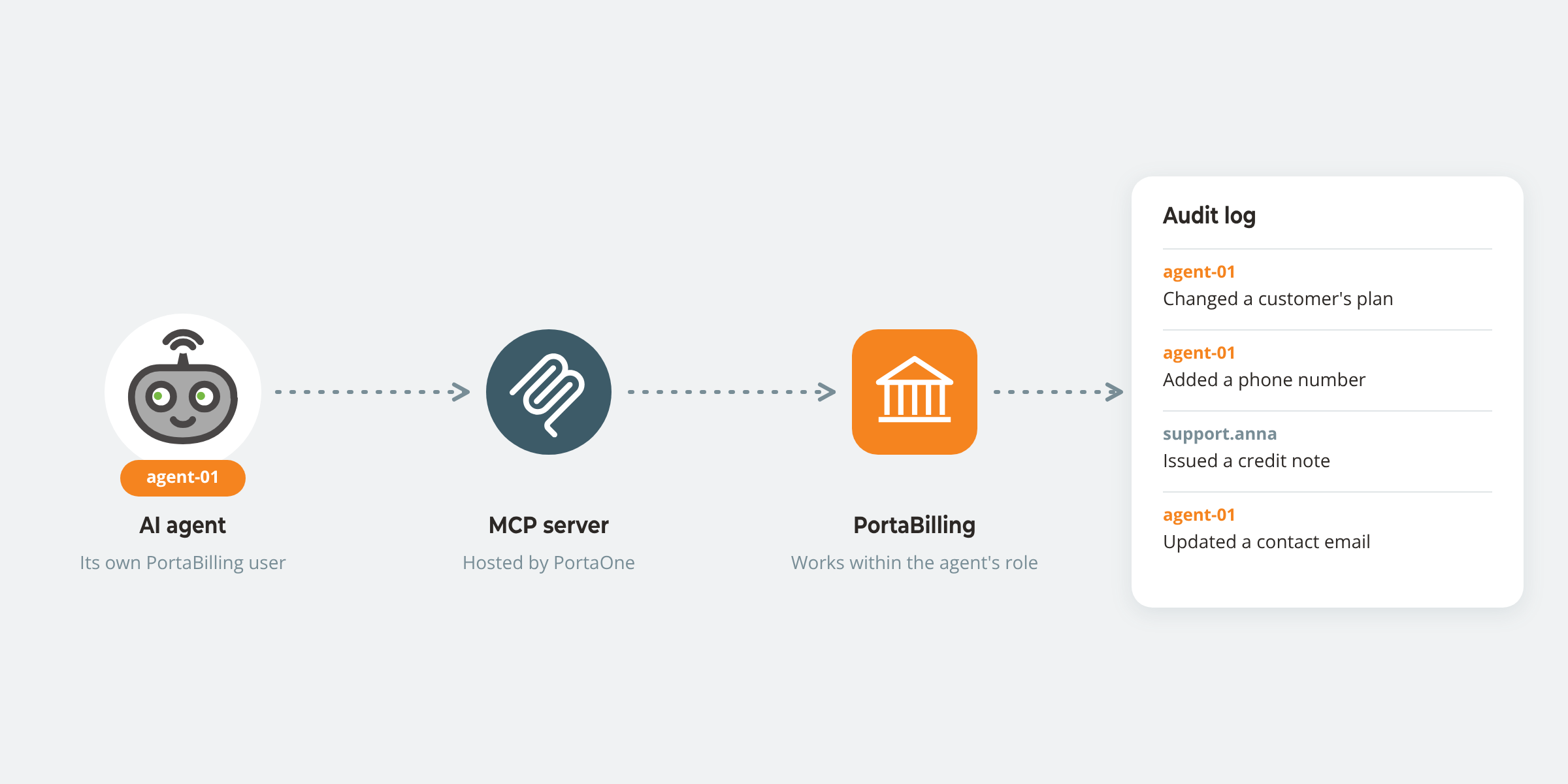
So the operator can look up which changes came from the agent and which came from its staff. That gives it a record of the agent’s work to measure against, in place of an estimate of “time saved”. To see it on your own setup, book a demo.
A test for the next billing cycle
An operator doesn’t need a big AI program to answer the finance question. Pick the path that fits:
| If you… | Try this | You’ll see |
|---|---|---|
| Sell AI capacity | Run your own pricing on PortaAIM, starting with a technical call | Usage, charges, and costs for every request in PortaAIM |
| Resell AI services | Put a price and a cost on one AI service in PortaBilling, such as an AI receptionist or transcription | After one billing cycle in PortaBilling: how many customers used it, what they paid, and what it cost you |
| Use AI internally | Give one AI agent its own PortaBilling login and role | The changes it made, under its own name in the PortaBilling audit log |
Back to the cloud PBX provider from the start. If the dental clinic’s AI agent takes 3-minute calls at $0.20 a minute, each call is a $0.60 charge that PortaBilling rates, with the AI provider’s cost recorded next to it. At the next monthly review, the answer to “where is AI on the P&L?” is a number from the billing system, instead of a slide.
FAQ
No. Large operators that built AI data centers or AI cloud earn 0.2% to 3.1% of total revenue from them, according to their 2026 filings. A smaller cloud PBX or SIP trunking provider can resell AI voice agents and call transcription from the PortaOne Add-on Mart and bill AI agent calls in PortaBilling with their own charge.
PortaBilling does. Calls to AI agents are a billable service alongside an operator’s existing voice services, with their own per-minute charge. A customer tariff in PortaBilling sets the price, and a vendor tariff records the AI provider’s cost, so both sides of each AI agent call are rated.
In PortaBilling, the operator sets its price for the AI service in a customer tariff and records the AI provider’s cost in a vendor tariff. For most setups, PortaBilling’s General cost/revenue statistics report then shows cost and revenue for a chosen period, sorted by the report type the operator picks, such as by customer and destination. For more complex pricing or cost structures, PortaAIM, or AI DataLink with its export to Google BigQuery, may fit better.
Yes. PortaBilling has a supported MCP server that connects AI agents to PortaBilling. PortaOne sells it as an Add-on Mart module, and hosts and maintains it. PortaAIM bills AI usage for AI and GPU cloud providers, and PortaBilling rates AI voice agent calls and call transcription as services an operator sells.