

When PortaOne began sending me from Kyiv to Oslo to support the launch of a Norwegian MVNO, I was not exactly arriving from a quiet place. And on some of these telecoms-related trips, I was joined by a colleague from Sumy, a region of Ukraine experiencing very heavy unrest.
So our idea of a dangerous neighborhood was not quite comparable to a Norwegian’s.
I asked the locals: is it safe to walk alone in the Holmenkollen woods? Or around the city at night? They looked at us as if I’d asked whether it’s safe to drink water. The forests, they said, are the safest part of Oslo. (Norwegians genuinely consider a forest a kind of public sports center. With moss. Where you recharge your batteries after work.) The walk from our hotel to the office, however, did pass through a notorious stretch — and one day a plainclothes police officer literally sat in our open-plan office next to me, watching some operation unfold across the river and reporting into a radio. That was the closest I ever got to Oslo crime drama.
Into the Danger Zone
So, my colleague and I decided to see if we could find the real bad part of the city. We were going to go #hunting-for-danger-in-oslo. The head of software development said, “Try Grorud, I played tennis there.” So, we took the metro out there, expecting something edgy. Accordingly, what we found was this:
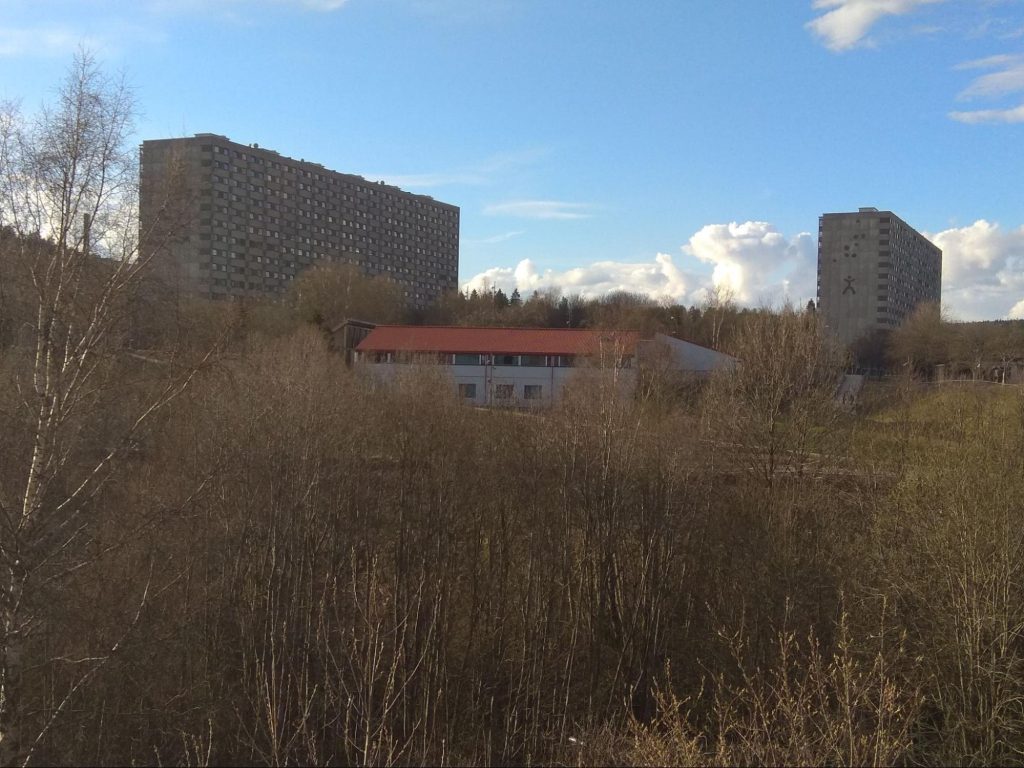
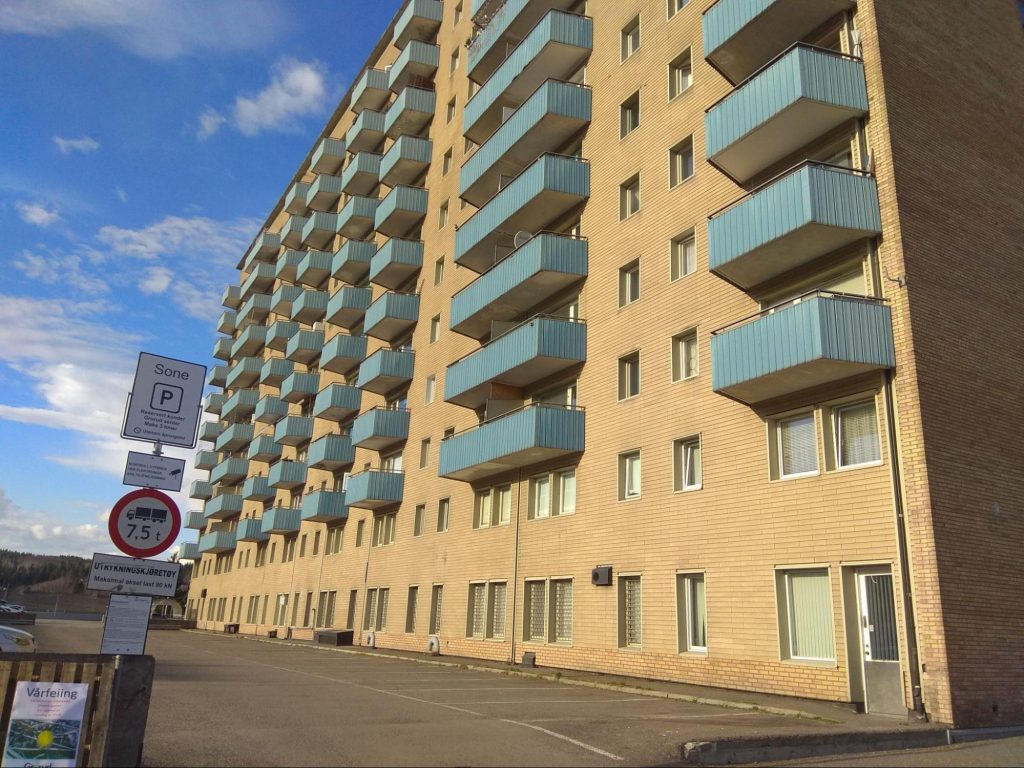
We looked around for about ten minutes. The “dangerous” Grorud streets looked like a slightly strange version of every neighborhood we knew from home. Meanwhile the forests of Holmenkollen genuinely do feel like a never-ending sports event.
That was my first lesson in Norway: the danger you imagine is almost never the danger that is actually there. Now, hold on to that thought, because we’ll come back to it later.
Whale Chocolates and the Real Cost of a Norwegian MVNO Launch {#whale-chocolates-and-the-real-cost}
Every time I flew home from Oslo, my two preschoolers had only one question. Not “Daddy, did you miss us?” Not “How was the flight?” The question was: “Did you bring the whales?” 🐋
There is, for some wonderful reason, a Norwegian chocolate that comes shaped like a tiny whale. From my kids’ standpoint, the MVNO project was a whale-chocolate delivery service with some confusing telecoms activity mixed in. They still remember that period fondly. To them it was the Whale Era.

To my wife, the trips were something else entirely. Let’s be completely honest: while I was in Scandinavia, working with telecoms and learning about Norwegian number portability, she was alone in our flat with two preschoolers. Bath time alone. Sick days alone. Tantrums at the supermarket alone. There is no business case in any pitch deck on Earth that captures that cost. So if you are reading this and you’ve ever held the fort at home while your partner was off supporting an MVNO launch — this paragraph is for you. You are the actual MVP. 🙏
And no, I do not receive compensation from chocolate manufacturers to mention them. Although, Hval Sjokoladefabrikk AS, if you’re reading — call me.
Beyond the Whales (and into Telecoms)
While I was getting the whale-era shipping logistics down to a science, I was also working shoulder-to-shoulder with the Norwegian MVNO team in their open-plan office. That kind of proximity is a gift. You hear what the product team argues about during their daily meetings. You feel the panic when a SIM swap goes sideways at 4 PM on a Friday. And you learn that number portability is not a line in a telecoms contract, it’s a small human drama with different number ownership rules played out 30 times a day at the delivery corner.
It was also there, at Fornebu, where I met some Telenor veterans who had worked with the founders of PortaOne back when this company did not even exist yet. (We’ve told that origin story elsewhere on this blog — go dig it up, it’s a good one.) Those are the kinds of telecoms conversations that don’t fit on a Zoom call. They happen at lunch, when somebody says, “You know, in 2003 we tried something similar, and it didn’t work because we had to activate SIM cards by calling the provider.”
Open-Plan Sonar: How You Tune to a Customer {#open-plan-sonar}
Whales — yes, the chocolate kind, but also the real kind — have one of nature’s most beautiful tools. Sonar. They send out a click into the dark ocean, and from the echo that comes back. Now they know exactly where they are, what’s around them, and where dinner is hiding. 🐋
By month four of my Norwegian routine, I realized I had grown my own little telecoms sonar. Consequently, I knew exactly:
- How that MVNO onboarded new subscribers (and which steps caused 80% of the support tickets).
- Which customer segments brought in the real margin and which were vanity numbers.
- What internal CRM limitations were quietly bleeding the team an hour a day.
- Which wholesale carriers were trustworthy and cheap.
When our PortaOne developers in Kyiv had a question — “Why do they need this edge case in call processing?” — I could answer without a meeting. I had become the customer’s proxy.
Seven Seas of Telecoms Sonar
But here’s the other thing: I was not the only sonar in the company. Across PortaOne, my colleagues were tuning into other telecoms-world oceans entirely:
- Dmytro had spent enough time in Australia, Malaysia, and South Africa to learn how to migrate Tier-1 operators and fine-tune PortaSwitch to local reality.
- Mike could tell you the unwritten rules of doing business voice in the Netherlands and Malta.
- Serhii had been in Africa long enough to map the local payment-collection minefield.
- Klaus carried half of the US and Canada in his head.
- Oleksandra and Lina had picked up the rhythm of Europe.
- Andriy, our CEO, had a sonar pointed everywhere at once that just comes with the job description).
And then there was me, in Scandinavia. That made seven. Together we were, basically, a small pod of whales scattered across the world’s seas, each of us listening for what our part of the telecoms ocean was telling us. And at every product meeting, we’d explain what we heard.
That worked beautifully. For about a decade.
The Telephone Booth in the Lobby (a.k.a. COVID Happens) {#the-telephone-booth}
In the lobby of Telenor’s Fornebu HQ, there is an installation. An actual, beautifully preserved old-school telephone booth — except that it’s no longer wired into anything. It’s now an art piece. A monument to the era when Norwegians genuinely needed a payphone, provided by their national telco. A relic. A vibe.
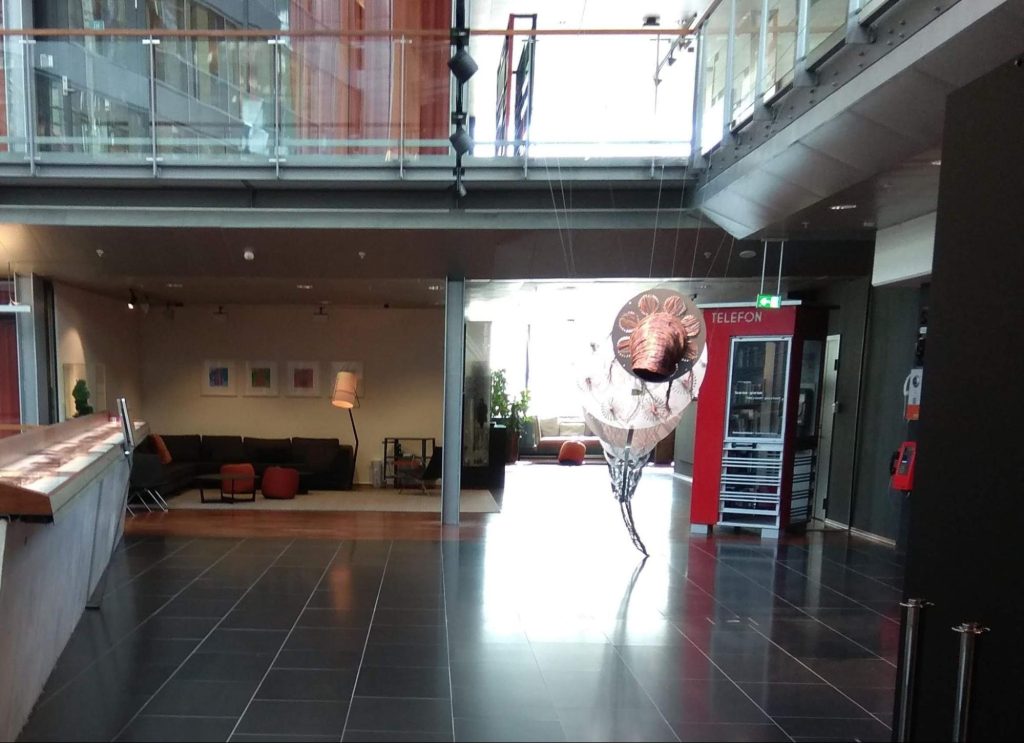
When COVID hit, something quietly tragic happened to our company-wide sonar. Site visits stopped. Training went remote. Conferences got postponed, then quietly cancelled, then Zoomed, then forgotten. The pizza-on-a-mountain debrief sessions we used to have after a long workshop? Yeah. Those were not happening anymore.

And here’s the uncomfortable bit. Without those site visits, those open-plan office hours, those pizzas at the top of the hill — many of us started feeling exactly like that telephone booth in the Fornebu lobby. Our connections to our telecoms customers, which used to be living, breathing, sometimes-irritating, always-meaningful things, slowly turned into… an art installation. A symbol of how it used to be. The exhibit was titled “Customer Intimacy, ca. 2018.”
LinkedIn helped. YouTube helped. Webinars helped. But let’s be frank. A Slack reaction emoji is not an echo from the deep ocean. 🦗
We needed a new sonar. A digital one. One that didn’t require any of us to fly to Palau.
(Yes, Palau. We have customers in Palau. If you’re reading this from Koror — hi 👋.)
The Wishlist: A Digital Sonar for an Ocean of Telecoms {#the-wishlist}
In 2026, we finally built it.
We took our existing support and development ticketing system — good old YouTrack, which has been the spine of PortaOne engineering for years — and on top of it we built wishlist.portaone.com. A portal where any customer with PortaCare access can:
- Submit a feature idea, change request, or suggest that “you guys really should do X.”
- See what other customers are asking for.
- And — this is the important part — vote on the ones that matter most to their business.
We put our best in the intro video: for years, when customers told us “this is a must-have feature, every PortaOne customer needs it,” our honest answer used to be, “Maybe.” Maybe you’re right. But how do we verify that? Were our product officers hearing from the entire customer base, or just from the loudest, most recent, or most influential voices in the room?
Now here’s where it gets clever, and a bit painful. And, honestly a bit fun.
Votes are not free. Every customer gets a quarterly allowance of “PortaTokens“:
- 🪙 PortaCare customers get 5 tokens per quarter.
- 🪙🪙 PortaCare Pro customers get 10 tokens per quarter.
- 🪙🪙🪙 PortaCare Pro Plus customers get 20 tokens per quarter.
Cost = Value
Tokens are shared across all the users in each of the telecoms in our customer family. One user, one vote per feature, within one company. Each upvote costs one token. Tokens reset every quarter and don’t carry over. You can withdraw your vote any time — and get the token back — unless the feature has already entered development. At which point: too late, you committed, that’s a real engineer eating real pizza now. 🍕
Why charge tokens at all? Because forced scarcity creates honest priorities. If everything is free, everything gets a vote, and the signal becomes noise. With a finite token budget, every customer has to ask themselves the only question that actually matters: of all the things we want, which ones will move the needle the most for our business this quarter?
Andriy Zhylenko, our CEO, has committed to dedicating a significant chunk of our development capacity to whatever the wishlist surfaces. Mike Kidik has committed to reviewing the top items at every planning session. The backlog is now visible to you — under review, being designed, in development, shipped — along with descriptive reasons.
For the first time in our PortaOne history, our product officers have a defensible, data-driven prioritization that looks across the entire customer base, not just the people who came to the last conference.
If you don’t have access to the portal, or your token balance shows zero, ping your PortaOne customer success manager. They’ll sort you out.
The Telecoms Plot Twist Nobody on Our Product Team Saw Coming {#the-plot-twist}
Here’s where the story takes a turn, and my Norwegian sonar got humbled by the global one.
When the wishlist went live and tokens started flying around, one feature climbed to the very top of the leaderboard. It wasn’t AI. And it wasn’t blockchain. It wasn’t some shiny next-gen UI. It was this:
- CLI Validation Using Number Portability. Our product team blinked. So did I. Let me explain why.
(A quick telecoms jargon-busting break: CLI stands for Calling Line Identification. In plain English, it’s the number that shows up on the screen of the person you’re calling, i.e., the caller ID. The whole purpose of CLI is to say, “Hi, this call is coming from this number, which is associated with this person/business/legitimate operator.”)
Now, back in the days when I was sitting in that Oslo office, the wholesale voice market in the Northern Europe telecoms industry operated on a kind of gentleman’s agreement. If you wanted to send calls into Telenor’s network, you could route them through a big Norwegian wholesaler called Kvantel, because it was cheaper than going direct. The call would arrive carrying some CLI. The terminating operator would let it through. The originating operator (or whoever first put it on the public network) was considered responsible for the validity of that CLI. Was it perfect? No. Was it abused? Sometimes. But did anyone lose sleep about it in 2018? Genuinely, no.
“We Don’t Need No Badges”… Or Do We?
It was like a nightclub where you could borrow a friend’s VIP badge to skip the line. The bouncer would glance at the badge, see it was the right shape and color, nod, and wave you through. Maybe he recognized you, maybe not. Either way, he trusted that whoever issued the badge had checked the right things.
So when our wishlist suddenly told us that operators all over the world wanted us to validate INCOMING CLIs from other operators, and BLOCK calls carrying national CLIs that don’t actually belong to that other operator — my first reaction was: “Are you sure? That’s not how this market works.”
But the wishlist is not one loud customer in a webinar. The wishlist is upvotes from different continents, different business models, different problem sets, all converging on the same complaint. That’s not noise. That’s a tide.
So, we listened, we looked, and we realized: the market had quietly changed underneath us.
- 📞 Robocalls and spoofed numbers had turned into a global epidemic. Regulators noticed.
- 🌍 Free roaming inside the EU made it harder to charge premiums for international traffic. So, telecoms started getting much pickier about which calls they let in cheaply.
- 💰 Some countries introduced extra termination fees for calls originating from abroad. Suddenly, “Is this CLI really domestic?” became a billing question, not a philosophical one.
- 🛂 Regulators in multiple regions started enforcing strict telecoms rules about who can use national phone number ranges as the displayed CLI on inbound calls.
Translation: the bouncers had changed. They no longer accept a borrowed VIP badge with a vague nod. They want the badge, the photo ID, and a face that matches both. And they would absolutely turn you away — or fine the venue — if you try the old trick.
A New Type of CLI Validation
Now, here’s the part that should embarrass me but actually makes me proud of the wishlist. PortaSwitch already had a small set of CLI-related features built up over the years:
- Charging by CLI and CLD.
- CLI validation using libphonenumber (Google’s open-source phone-number-parsing library — yes, the same one that powers your Android dialer 📱).
- STIR/SHAKEN support for cryptographically signing and validating call origin — a US-led standard that PortaOne has had since long before it was cool.
- CLI enforcement on outbound traffic that we’ve been shipping since around 2010.
And our product team’s honest first reaction to the wishlist was: “Wait, we have like seven flavors of CLI validation already. What are they actually asking for?”
Turns out, they wanted an eighth flavor. Not on outbound. On inbound. Validating the CLI of calls coming in from other operators, blocking calls that carry national CLIs that demonstrably don’t belong to that originating operator’s allocation. A new piece of bouncer logic for a new kind of doorman.
If we hadn’t had the wishlist, we’d have kept building features for a telecoms nightclub that no longer existed. The wishlist is what told us the venue had been renovated. Without it,perhaps we’d still be assuming the 2018 Norway paradigm was fine, or imagining a danger that’s not actually there.
Lines of Code Are Cheap Now. Working Solutions Are Still hard. {#lets-be-frank}
Let me close with the part that matters most.
We live in a deeply weird software era. With open-source ecosystems, AI coding agents, and a telecoms architecture like PortaSwitch (which, by the way, ships with open source code so customers can extend it themselves), writing a line of code is approaching, in some real sense, free.
What’s not free, and what is in fact getting more expensive every year? Support and the ability to know which line of code is the correct one to write next.
This is the genuine, unsexy, weird truth of telecoms in 2026. The engineering problem is mostly solved. The listening problem is not. A line of code costs you nothing if you build the wrong feature. A line of code that solves the right pain — that’s the difference between a product roadmap and a graveyard.
Our colleagues’ sonars — the ones tuned to Australia, Nigeria, the Netherlands, Norway, Latin America — those were beautiful, and they still matter. But they were never going to scale to every customer in every country, all at once, all the time. (And none of us are flying to Palau next Tuesday 🇵🇼)
A New Sonar for a New Era
So we built a digital sonar. The PortaOne wishlist is now how we hear the entire ocean at once. It’s how we caught a market shift that nobody on our product team had on their radar. It’s how, going forward, we’ll catch the next one.
If you’re a PortaOne customer and you haven’t checked your token balance yet — go to wishlist.portaone.com, sign in with your YouTrack credentials, and tell us what’s actually broken in your business this quarter. Don’t be polite. Don’t filter. And don’t wait for the next webinar. Click the upvote, spend the token, and let the sonar do its job.
And if your balance shows zero, or you can’t get into the portal, or you have no idea what a PortaCare tier is — ping your customer success manager. That’s literally what they’re there for.
You keep clicking. We will keep listening. Together we’ll build a 2027 roadmap that’s a lot less about what we think you need, and a lot more about what you actually told us. 🚀
(And if anyone happens to be flying back from Oslo soon — bring whales. The kids are now teenagers, but I have it on good authority that they still accept chocolate. 🐋)
Want to talk to a human about any of this? Drop a note to our sales team, or write directly to Andriy on LinkedIn — he reads every message, including the strange ones. Especially the strange ones.