
The solution becomes clearer once you know what your customers are actually trying to solve.
Ask a room full of VoIP providers whether they need a mobile app or a web dialer and most will say both. That’s the right answer, but it sidesteps a more fundamental question: which one is doing the heavier lifting in your sales conversations, your onboarding process, and your support queue?
For most providers selling to businesses — cloud PBX customers, remote teams, SMB clients, call centre businesses — the web browser can significantly remove real customer friction. For providers, that is not a product decision. It is a sales and operations decision. And yet the web dialer is often treated as an optional extra rather than the front door.
Here is why that perspective is worth revisiting.
Mobile is essential. Just not the whole argument
Nobody is suggesting providers drop their mobile apps. Field staff, executives, and sales teams on the move absolutely need a VoIP app that works on their phone. A provider without a mobile option is not a serious contender for most business deals.

But when a business buyer sits down to evaluate a communications platform, the questions they actually ask tend to sound like this:
- Can our team use the same extension at home as they use in the office?
- How long does it take to get 50 remote agents making calls?
- Does this fit inside our CRM, or are we asking people to switch tools every time the phone rings?
- What about the team members on Linux laptops or shared devices — are they just excluded?
Those are not mobile app questions. They are browser questions. And if your offer cannot clearly address them, you are leaving a gap that a competitor with a decent web dialer will fill.
The browser removes the first wall — and the biggest one
Getting a native mobile app in front of business users takes more steps than it should. App store downloads, device-level permissions, OS version compatibility, MDM policies, provisioning per handset. None of these are deal-breakers, but every one of them creates friction that can stall onboarding.

A web dialer removes almost all of that. All you do is send a URL; your customer simply opens it, logs in, and can start making calls immediately. There’s no need for downloads, IT assistance, or waiting on app store approvals. It works across Windows, Mac, and Linux — whatever is on the desk.
For providers, that simplicity has a real commercial value. Customers who get up and running quickly are less likely to second-guess the purchase. Customers who can self-serve from a browser generate fewer requests to customer service in week one. And when you are selling into a business with 20 remote workers all on different hardware, the browser is the only access layer that works universally across platforms.
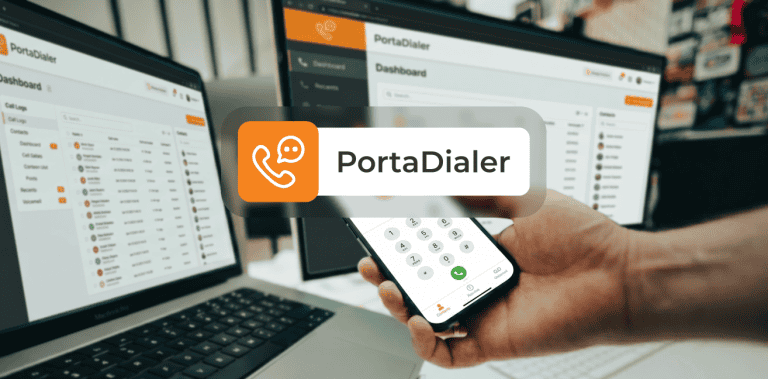
This is exactly why we built PortaDialer the way we did. It is a fully branded, white-label VoIP softphone that gives providers iOS, Android, and a WebRTC browser dialer in one product — connecting to any SIP-based PBX or cloud telephony platform with no infrastructure changes and no complex integrations. Your customers get a complete business calling experience across mobile and browser, and you get a product that is faster to deploy and easier to support than any native app.
Business calling requires more than a soft consumer experience
Your customers are not buying a softphone because they need another way to make calls. They already have ways to make calls. What they need is a proper business phone system that travels with their team.
That means:
- Attended and blind call transfer — so agents can hand calls off without dropping them
- Internal extension dialling and directory lookup — so the office feels connected even when nobody is in it
- Voicemail access and call recording — for compliance, training, and accountability
- Presence indicators — so teams can see who is available before they transfer
- Popup notifications — so no calls are missed even when working in another tab or window
All of that needs to work across mobile and browser, consistently, without asking your customer’s IT team to maintain two separate systems.
So, web or mobile?
Both — but the order matters.
Mobile is for your customers when they’re on the move. A web dialer is for their whole office setup.
When you can hand a new customer a URL instead of a rollout plan, you reduce time-to-value. When your support team can reproduce and diagnose a problem in a browser tab rather than on a specific device running a specific OS version, you reduce support overhead. When you can onboard 200 agents the same way you would onboard five, and without engaging in a device management project, you remove a blocker that kills deals.
The web dialer also makes your wider solution stickier. A provider that gives customers browser-based calling, properly integrated with their CRM and fully branded as their own, is not just selling a phone system. They are selling a workflow. And that is harder to compete against than a lower price from a competitor.
The strongest offer gives customers a communication solution that works wherever work happens — with the web dialer as the everyday engine and mobile as the freedom layer on top. That is what serious business calling looks like, and it’s an offer that’s getting easier to build, deploy, and sell with the right softphone partner.
Want to see how PortaDialer fits your existing platform?