
Short answer: When you compare usage billing platforms for AI, what you still build is the zero-balance cut-off: Metronome’s, Orb’s, and Lago’s own docs leave it to your system to act on their balance alert. PortaAIM‘s proxy gateway enforces each customer’s session policy, so you keep no enforcement code, and you can still connect your own gateway, as with other billing tools.
Metronome, Orb, Lago, and Chargebee all meter the usage on your new token endpoints. Stripe‘s own docs call Metronome their primary usage billing platform. So metering is not what separates them. What does is the moment a customer’s balance hits zero, and whose code stops them.
That gives you a one-line test for any vendor: who acts when the balance hits zero, and whose code handles it? Look at each vendor’s own documentation and the answers stop looking alike.
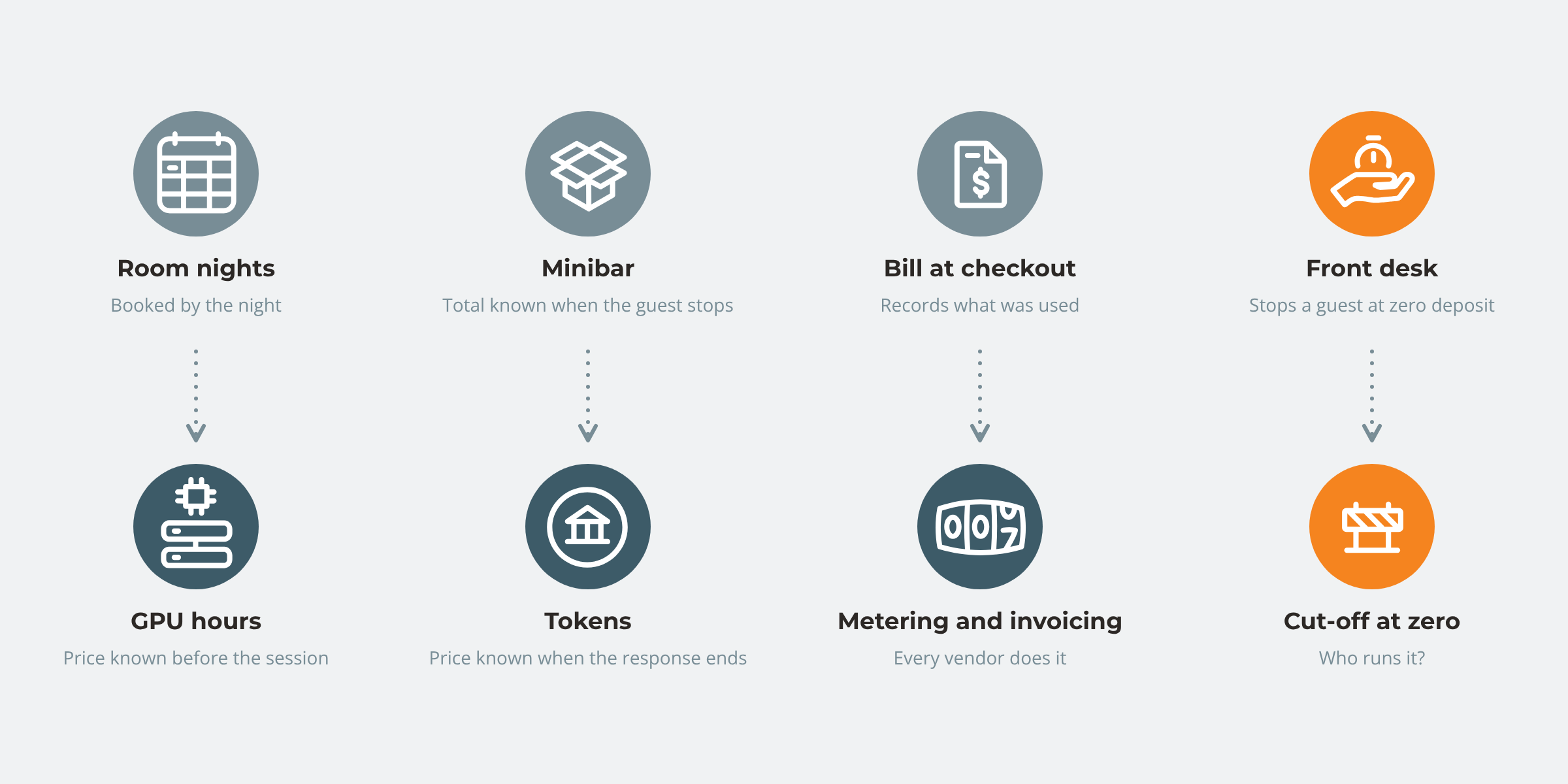
Room nights were easy; tokens are the minibar
Think of your platform as a hotel. Renting GPU hours is selling room nights: the guest books by the night, and the price is known before check-in. Your hourly billing code was built for that, and it works.
Tokens are the minibar. Each item is cheap, nobody knows the total until the guest stops, and many guests open the fridge at once.
A hotel handles a guest’s money in two places. The bill at checkout records what was used: that’s metering and invoicing, and every vendor here does it. The front desk stops a guest whose deposit has run out: that’s the cut-off at zero. The question for each vendor is whether it runs the front desk or leaves it to you. A hotel that already runs a front desk it likes will want to keep that one.
Who acts at zero, in each vendor’s words
Each competitor row comes from that vendor’s own pages.
| Platform | When the prepaid balance runs out | Who acts at zero |
|---|---|---|
| Stripe Billing | See the next row (Metronome) | Metronome, its recommended start for all new integrations; see the next row |
| Metronome | Recommended signal – an alert at a $0 balance | Your own system cuts the customer off, and Metronome recommends your system and database hold entitlement state |
| Orb | A webhook when the balance is used up or below a threshold you set | You block access when the depleted alert arrives |
| Lago | Balance alerts fire webhooks | Your product acts on them, and your app decides on live calls |
| PortaAIM | Worst-case cost, from the model and maximum response size, can be reserved before the request runs; paid services stay blocked at zero until the customer tops up, then usage resumes | Its own proxy gateway enforces each customer’s session policy, with no enforcement code of yours; you can still connect a gateway of your own, as with other billing tools |
The last column is the front desk. Metronome’s, Orb’s, and Lago’s own docs give it to your code: each sends an alert or a webhook at $0, a message to a desk you have to staff. Stripe’s recommended route ends at the same desk, since it starts on Metronome.
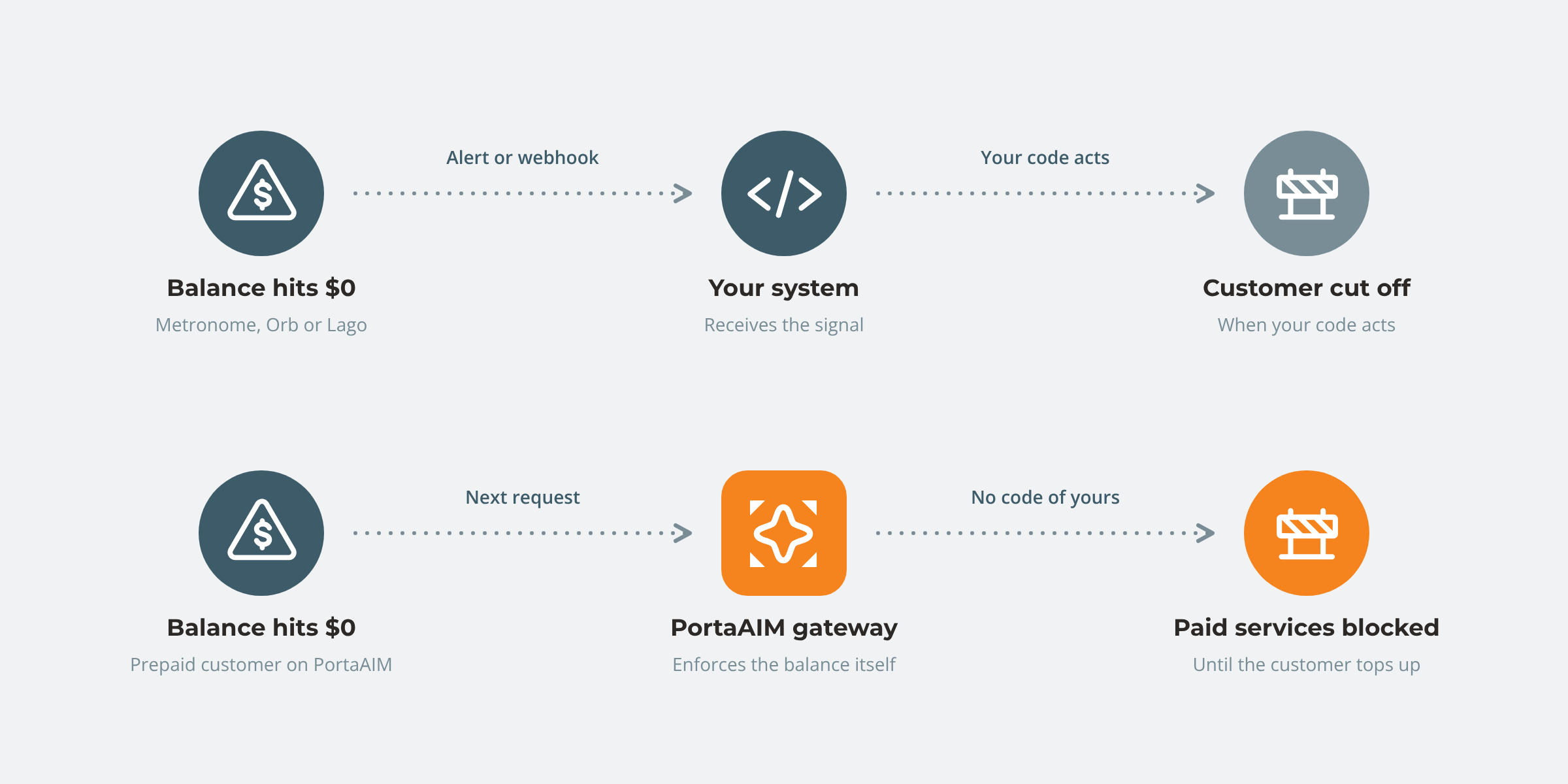
Orb’s row hides a detail. Usage that arrives after the balance runs out is charged on the month-end invoice. So the minibar stays open until your front desk acts, and whatever is taken meanwhile can go on the bill at checkout.
Lago says it plainly. It rates and invoices, and your app makes the call on whether a live request starts or stops. When a balance alert fires its webhook, your product picks the response: throttle, block, allow overage, or offer a top-up. That’s a flexible front desk, and your team staffs it.
The front desk you’d be building
Add up what those pages ask of you and the desk takes shape in your repository. Something has to turn an alert or a webhook into a cut-off. Something has to hold the entitlement state that Metronome’s guide recommends you keep on your side. And Lago’s Python Agent SDK sends token or model-cost events without holding up the LLM call. That’s good design for metering, since counting should never slow a request down. It also means the metering stops nothing.
None of this is hard to build in a sprint, but the cost comes later, in keeping it right. A new model ships with new prices, a customer changes plans, and the handler becomes what somebody patches instead of the product you sell.
Timing is the deeper problem. Metronome’s and Orb’s docs note that a stop event goes out once the balance has already hit zero or been used up. A handler waiting on that event, rather than a preventative threshold you set, acts after the balance is already gone. That’s why we would choose a billing platform by its front desk first and its metering second.
A front desk built in
The other approach is a billing platform that runs the front desk itself. PortaAIM’s built-in gateway enforces each customer’s balance and policy, so you don’t write or maintain that code: the handler from the last section is gone from your repository. A provider already running a gateway it likes can still connect it, as with other billing tools.
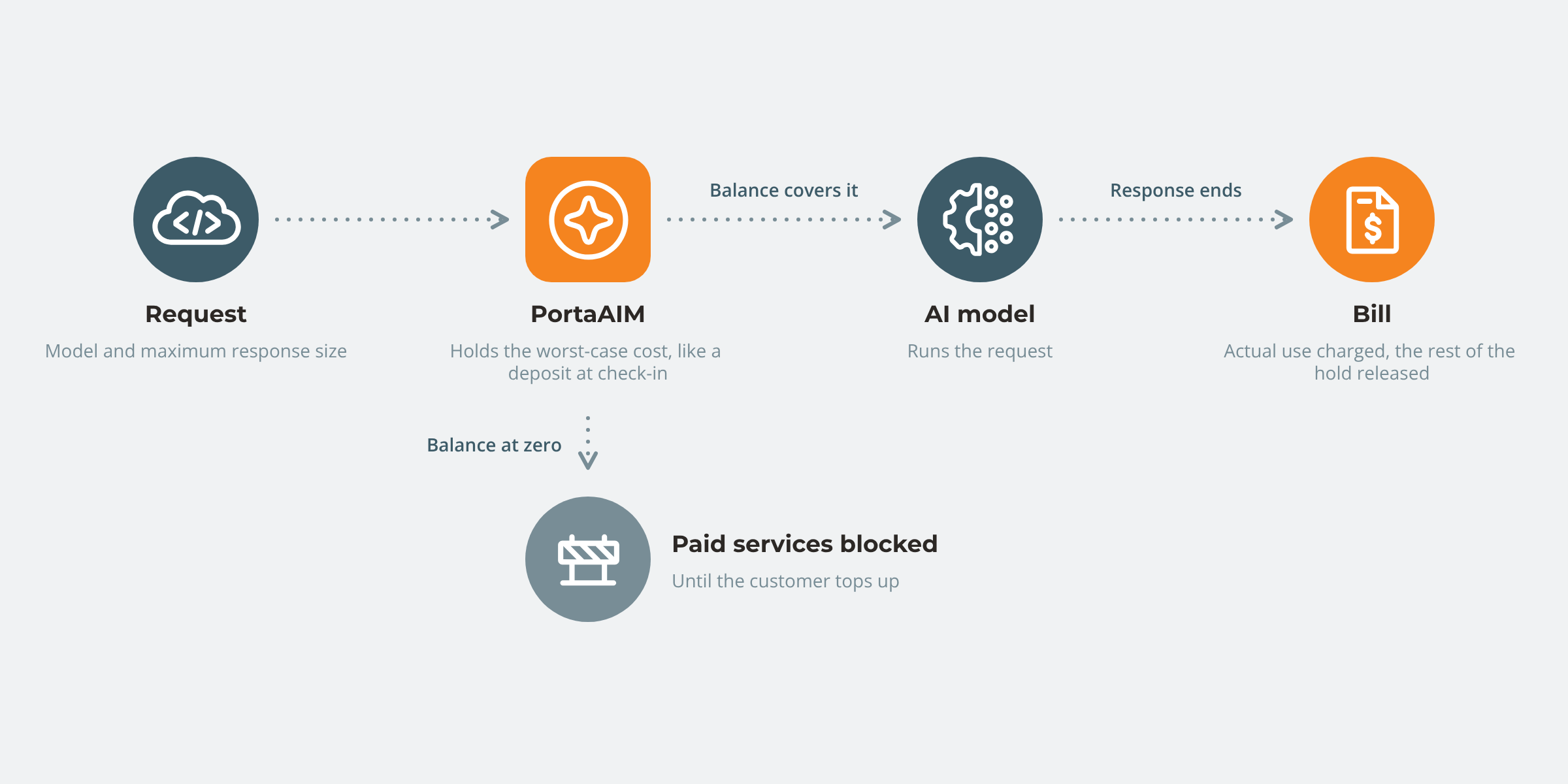
PortaAIM also takes a deposit hold, the way a hotel does at check-in. Before a request runs, it can work out the maximum that request could cost using the selected model along with the maximum response size, and reserve that amount. With that reservation in place, a prepaid customer who reaches a zero balance has paid services blocked until the customer tops up, and usage then resumes.
Book a technical call about your own cut-off rules
What to ask in the next demo
Take the hotel into your next billing demo: skip the bill, spend the hour on the front desk, and ask:
- what acts when this customer’s balance hits zero, and ask to see it happen rather than hear it described.
- whose repository holds that code, and who gets woken when it breaks?
- what happens to usage that lands after the alert, and which invoice it appears on?
The bills will look alike from one demo to the next. If the answer to the first question is a webhook, you have just met the front desk you would be staffing.
Get a quote built on your own usage
Sources: competitors’ own pages and documentation, read 16 November 2026. Our product documentation, read 16 November 2026.
FAQ
Choose the one that does the enforcing for you, rather than leaving it to a handler your team writes and maintains. PortaAIM includes a proxy gateway that enforces the session policy for every customer, so your engineers do not write or maintain enforcement code for it. Teams that already run a gateway can still connect it, as with other billing tools.
PortaAIM meters API calls, tokens, compute minutes or any unit you define. A model can carry its own price for each usage dimension: input and output come preset, and cached input or output can be added.
Move the cut-off out of the scripts first, since that is the code that has to be correct at zero. In PortaAIM, the session policy of each customer is enforced by a built-in proxy gateway, so none of that enforcement code lives in your scripts. A gateway you already run can still be connected, as with other billing tools, while payments stay with your own payment provider, Stripe included.
Whichever tool you pick, ask what it does when a customer’s prepaid balance reaches zero. Before a request runs, PortaAIM can reserve the most it could cost, based on the model selected and the biggest response permitted. With the reservation held, paid services for a prepaid customer at zero stay blocked until they top up, after which usage resumes.
PortaAIM comes with its own proxy gateway that enforces each customer’s session policy, so you carry no enforcement code. Metronome’s, Orb’s, and Lago’s own docs state that acting on a balance alert or webhook, including the cut-off, is the responsibility of your system. If you already run a gateway, you can still connect your own, as with other billing tools.