
A startup MVNO does not need roaming agreements with hundreds of foreign operators. MVNO roaming usually runs on agreements someone else already has. Either the host MNO’s agreements work with the MVNO’s own IMSI (international mobile subscriber identity), or a sponsor’s agreements work with a second IMSI the sponsor owns. That second setup is called sponsored roaming. Either way, the commercial side is largely solved before launch. What decides whether roaming makes or loses money is how the MVNO’s billing connects to these networks, and how quickly it sees roaming usage.
This article explains the two ways MVNOs roam, how sponsored roaming and multi-IMSI SIMs work, where roaming margins leak, and what to check in your billing before you launch a roaming service.
Two ways to use roaming agreements that already exist
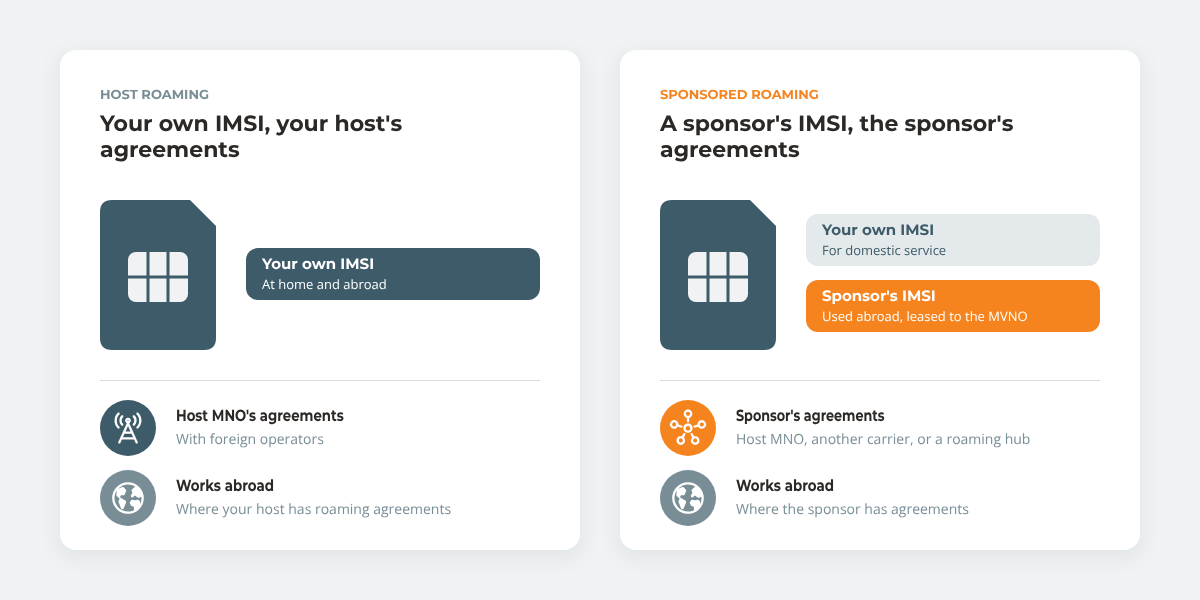
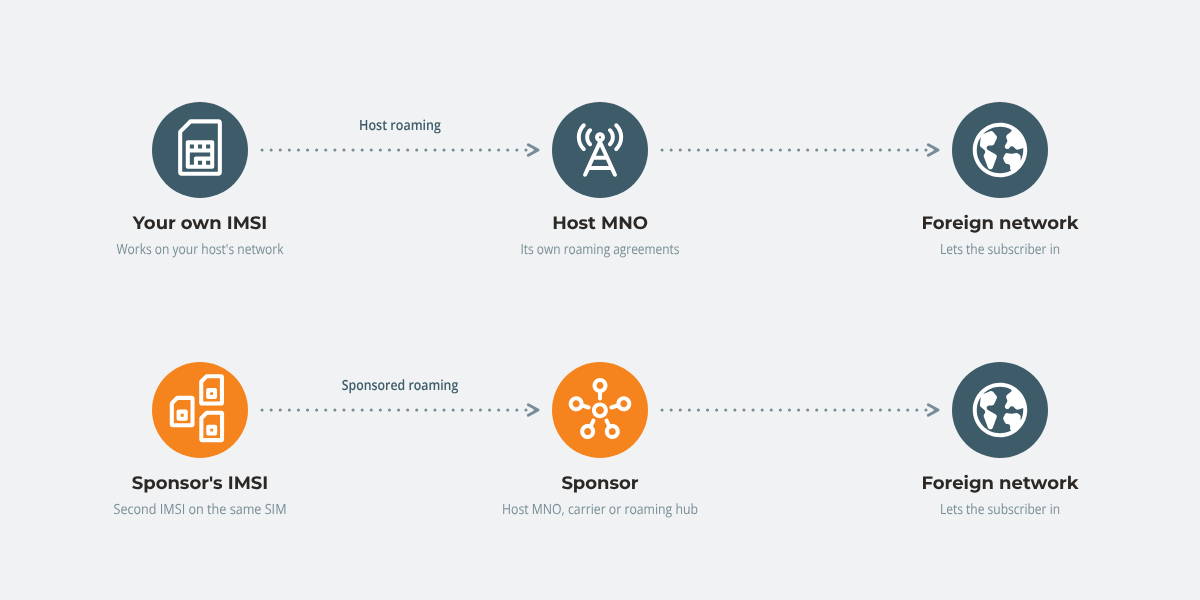
Direct roaming agreements take scale, time, and bargaining power that a new MVNO rarely has. So most MVNOs use agreements that already exist. With host MNO roaming, subscribers roam on the MVNO’s own IMSI, through the host’s agreements with foreign operators. With sponsored roaming, they roam on a second IMSI that belongs to a sponsor, through the sponsor’s agreements. The sponsor can be the host MNO, another carrier, or a roaming hub. Either way, the partner charges you its wholesale rates, and you set your own retail prices on top.
How multi-IMSI makes sponsored roaming work
Every SIM carries an IMSI, the number a network reads to work out which operator a subscriber belongs to. Abroad, your own IMSI only works where your host has roaming agreements. A sponsor’s IMSI opens the networks the sponsor has agreements with.
A multi-IMSI SIM or eSIM solves this by holding more than one identity:
- your own IMSI for domestic service
- an IMSI from the sponsor, issued from the sponsor’s own range and leased to the MVNO, used abroad
When the subscriber lands in another country, the SIM switches to the sponsor’s IMSI, and the local network sees a subscriber from an operator it already has an agreement with. In PortaBilling, the second IMSI is linked to the same subscriber, so roaming usage lands on the right account. The same SIM technology lets an MVNO work with several host networks, which the PortaOne MVNO billing page covers in detail.
MVNO roaming margins leak when you see usage too late
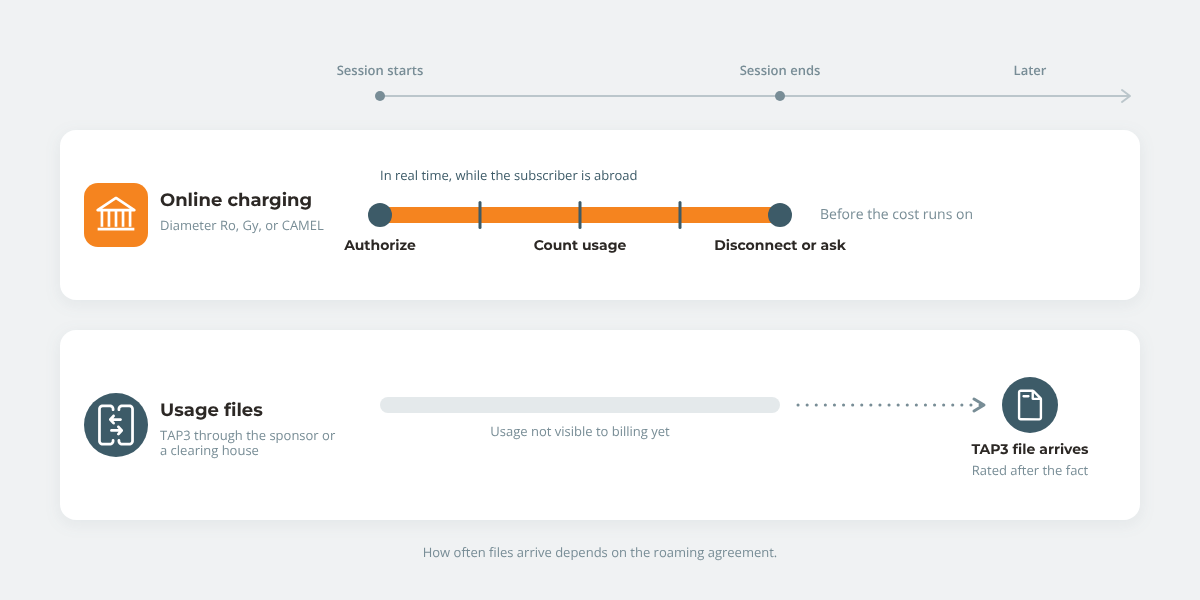
The sponsor bills you for everything your subscribers use abroad, whether or not you managed to charge for it. If roaming usage reaches your billing hours or days later, one subscriber streaming video on vacation can run past their balance and into your margin before anything stops them.
Real-time charging closes that gap. The billing system authorizes each session as it starts, counts usage against the subscriber’s bundle or balance, and disconnects or asks the subscriber before the cost runs on.
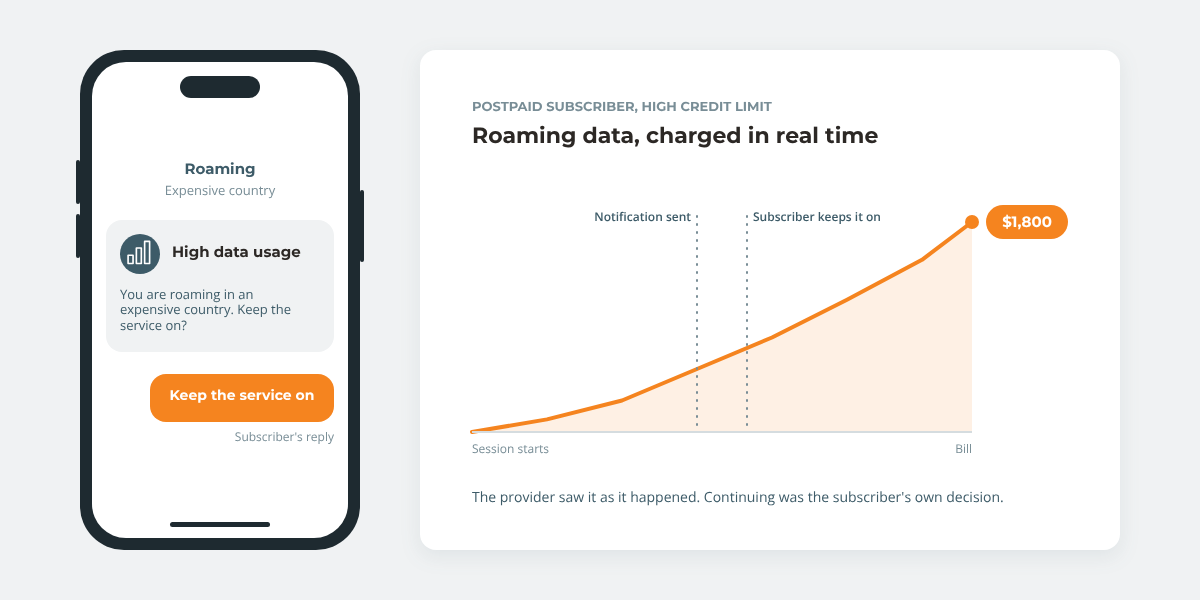
One provider PortaOne works with saw this with a postpaid subscriber who had a high credit limit. While roaming in an expensive country, he received notifications about his high data usage and asked to keep the service on. The bill reached $1,800. Because the usage was charged in real time, the provider saw it as it happened. Continuing was the subscriber’s own decision, not a surprise on next month’s invoice.
The real roaming question is integration with your host
Most of the work in launching MVNO roaming is not the agreement. It is agreeing, roaming partner by roaming partner, whether usage reaches your business support system (BSS) and online charging system (OCS) in real time or as files, and making sure the same session is never charged twice. With sponsored roaming, usage goes to the sponsor first, because the IMSI is the sponsor’s. There are two paths:
- Online charging: The network asks your OCS to authorize usage in real time. For roaming, PortaBilling does this over Diameter Ro for calls and SMS and Diameter Gy for data routed back through the home network, or over CAMEL through a partner’s CAMEL-to-Diameter gateway, and disconnects a customer who runs out of bundled services or funds.
- Usage files: The foreign network sends TAP3 files (the GSMA format for roaming usage records) to the sponsor, and the sponsor or its clearing house forwards them to you. How often depends on the roaming agreement. PortaBilling imports TAP3 versions 3.1 to 3.12, as well as CSV.
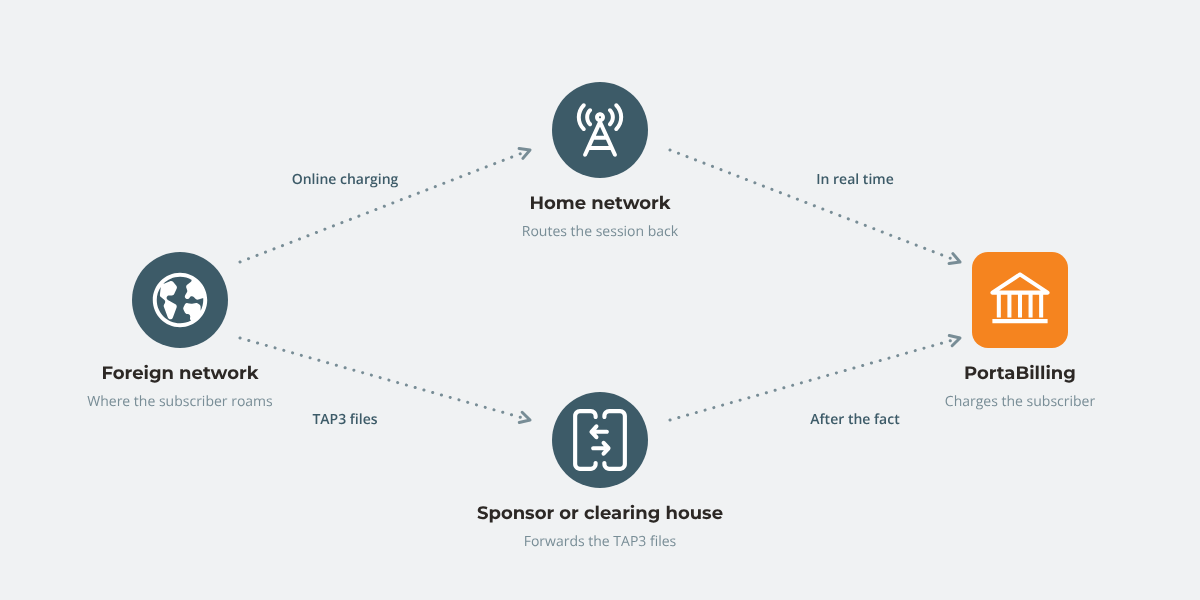
Online charging protects the margin. Files only tell you what already happened, so treat them as the fallback for partners that offer nothing else. If your host runs core equipment PortaOne has already integrated with, such as Huawei, ZTE, Adax, Yate, WTL, or IPLOOK, the PortaBilling integration phase is faster and costs less.
What to check before you launch MVNO roaming
Check these before you launch roaming:
- Coverage and rates: Which countries your host and any sponsor cover, and the wholesale rate for each.
- Charging per roaming partner: Whether each partner supports online charging or only usage files. This depends on the host’s or sponsor’s agreement with each foreign operator.
- Integration: Whether your billing vendor has already connected to your host’s core equipment.
- Roaming zones and prices: Retail rates per roaming zone that sit above the wholesale rates, with limits enforced from day one. Our PortaBilling documentation shows how to set up roaming zones and tariffs for real-time charging.
- Testing: In PortaBilling, plans and bundles can be prepared before the host connection exists, but every plan has to be tested once connectivity is in place.
Host and sponsor agreements give a startup MVNO international coverage on launch day. Whether that coverage earns money comes down to whether billing charges roaming in real time or finds out about it afterwards.
FAQ about MVNO roaming
Sponsored roaming means an MVNO’s subscribers roam on a second IMSI (international mobile subscriber identity) that belongs to a sponsor, using the sponsor’s roaming agreements instead of the MVNO’s. The sponsor can be the host MNO, another carrier, or a roaming hub. The MVNO still charges subscribers through its own billing system, such as PortaBilling.
Usually not at launch. A startup MVNO can roam on its own IMSI through its host MNO’s agreements, or on a sponsor’s IMSI through the sponsor’s agreements, and set its own retail prices, with PortaBilling charging subscribers for that usage.
The network asks the MVNO’s online charging system to authorize each session. For roaming, PortaBilling does this over Diameter Ro for calls and SMS and Diameter Gy for data routed back through the home network, or over CAMEL through a partner’s CAMEL-to-Diameter gateway, and disconnects a customer who runs out of bundled services or funds.