
Pakistan’s first MVNOs should expect two conditions from day one: a prepaid-led market and very thin per-subscriber economics. PTA’s latest ARPU indicator shows mobile average revenue per user (ARPU), voice and data combined, were roughly PKR 306 per month in 2024 to 2025. That does not make prepaid and low ARPU the same thing, but in Pakistan they point to the same platform requirement: charging has to be accurate while the service is in use, not reconstructed after the fact.
That is why real-time charging belongs at the start of an MVNO launch plan. A prepaid MVNO is not only choosing a price plan. It is choosing how every call, SMS, data session, bundle activation, balance transfer, and top-up will be authorized, rated, and committed while customers are consuming the service. If the online charging system (OCS) is too loose, balances can go negative. If it’s too conservative, paying customers can be blocked. Both are revenue assurance and customer-experience failures.
PTA’s MVNO license template adds time pressure: the license can be terminated after one year of issuance if the licensee cannot comply with the commencement requirements. In a low-ARPU prepaid market, real-time charging has to work on launch day.
Why prepaid dominates in a market like Pakistan
Prepaid fits Pakistan’s market conditions because it matches how many subscribers already control spending, manage risk, and recharge service.
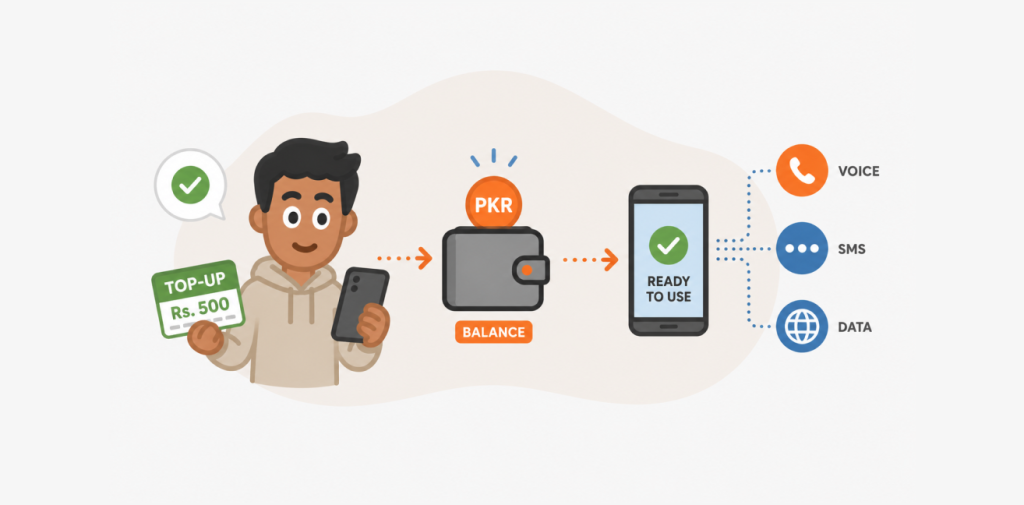
Budget control. When income is variable, a prepaid plan lets a subscriber spend what is available and adjust week to week, without a fixed monthly obligation. That makes small, frequent top-ups a normal usage pattern rather than an exception.
Credit risk. Postpaid billing requires some way to assess whether a customer will pay later. Where credit history data is incomplete for a large share of the population, prepaid is the more practical default because payment happens before consumption.
Access patterns. PTA’s HIES 2024-25 summary reports that over 96% of households have access to mobile or smartphone facilities and more than 70% use internet services. Household access is broad, but individual ownership and device affordability still shape how people use mobile services. GSMA’s 2026 Mobile Gender Gap work also points to persistent gaps in mobile ownership and smartphone ownership across low- and middle-income markets, including South Asia. MVNO billing platforms must therefore support low-denomination usage, shared-device behavior, and subscriber control over spend.
Recharge distribution. A prepaid billing system built for Pakistan should support the channels subscribers actually use: airtime vouchers, Unstructured Supplementary Service Data (USSD), mobile wallets, agent-based cash top-up, and app-based recharge. Real-time charging only delivers value if recharging is just as fast as charging.
What changes underneath when billing is prepaid
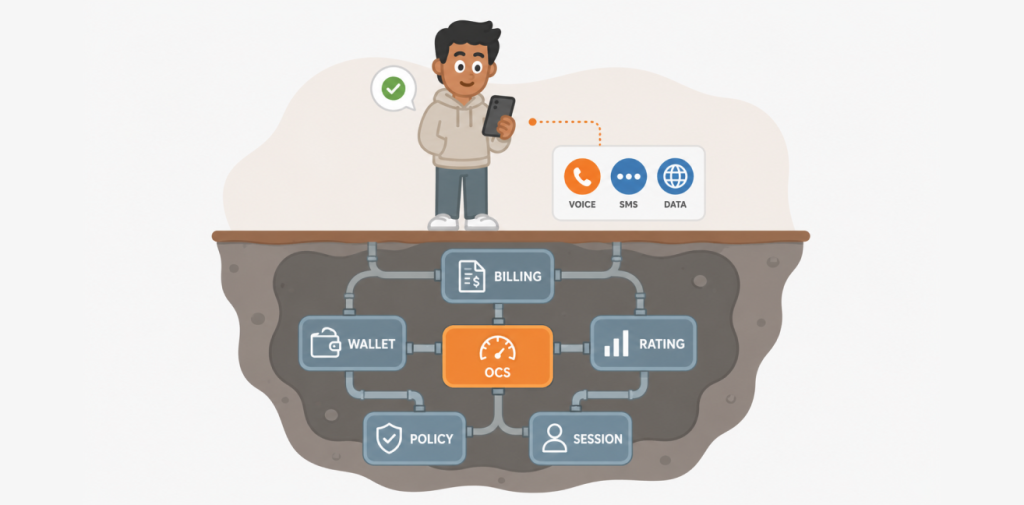
The commercial difference between prepaid and postpaid is obvious to anyone in the market, but the underlying technical details can get MVNOs into trouble.
Credit risk moves. Postpaid exposes the operator to non-payment after usage. Prepaid reduces that exposure, but only if the platform prevents customers from consuming services beyond the amount already paid for.
Revenue timing changes. Prepaid collects cash upfront while postpaid collects after a billing cycle closes. That makes balance accuracy a live operational requirement rather than an end-of-month reconciliation task.
Usage control becomes part of the product. A prepaid subscriber is actively managing spend. This means features like balance visibility, top-up speed, bundle activation, throttling, and service are all part of the product experience, not back-office details.
Hybrid offers need one rating engine. Many operators layer postpaid-style features, such as data add-ons or controlled overage, onto a prepaid base. New MVNOs must think about this for their launch. One product catalog, rating engine, and balance view should be able to cover prepaid, hybrid, and postpaid-style offers without rework.
How real-time charging works inside the OCS
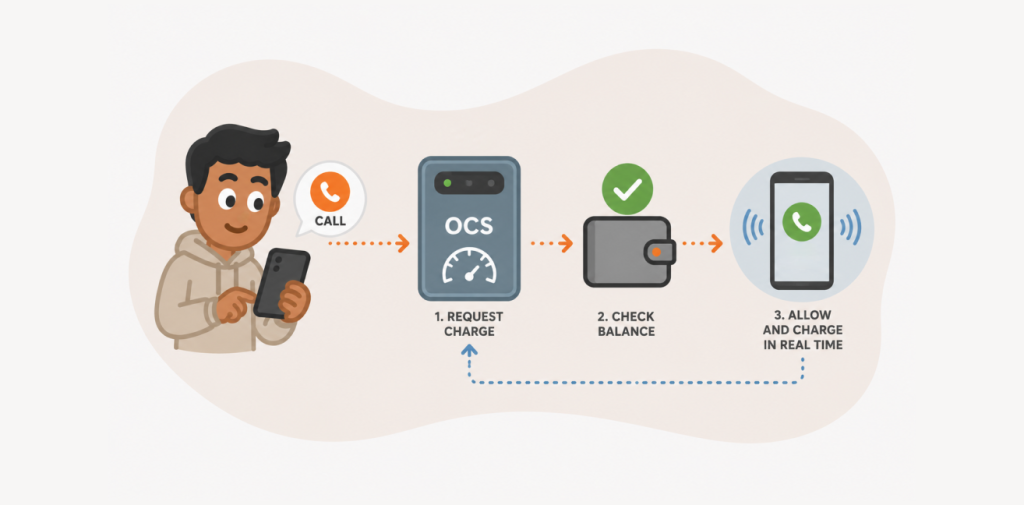
Real-time charging is the mechanism that makes prepaid service possible. The component responsible for it is the OCS. It’s the part of an MVNO billing system that decides, in the moment, whether a session can proceed and how much balance or quota should be reserved for it.
The basic loop is authorize, reserve, rate, and commit. Before a call, data session, or SMS goes through, the network asks the OCS for permission. The OCS checks the subscriber’s balance, product rules, and active bundles, then reserves a quota large enough to cover the next portion of usage. Usage is rated as it happens. When the quota is used up, or when the session ends, the charge is committed, any unused reservation is released, and the balance is updated. If the session continues, the OCS authorizes another quota.
On the network side, packet-data charging typically runs over the Diameter Gy interface between the OCS and the packet gateway. Voice and SMS online charging depend on the network architecture, with IMS/Ro, CAMEL/IN, and equivalent integrations still in active use. For MVNOs, the billing platform must be integrated deeply enough to make charging decisions before and during usage, not after usage records arrive.
Why quota control matters in real life
Quota reservation sounds simple until multiple services or multiple users draw from the same balance. SMS is relatively straightforward because the price of one message is known in advance. Voice and data are different because duration and consumption are unknown at the start of the session.
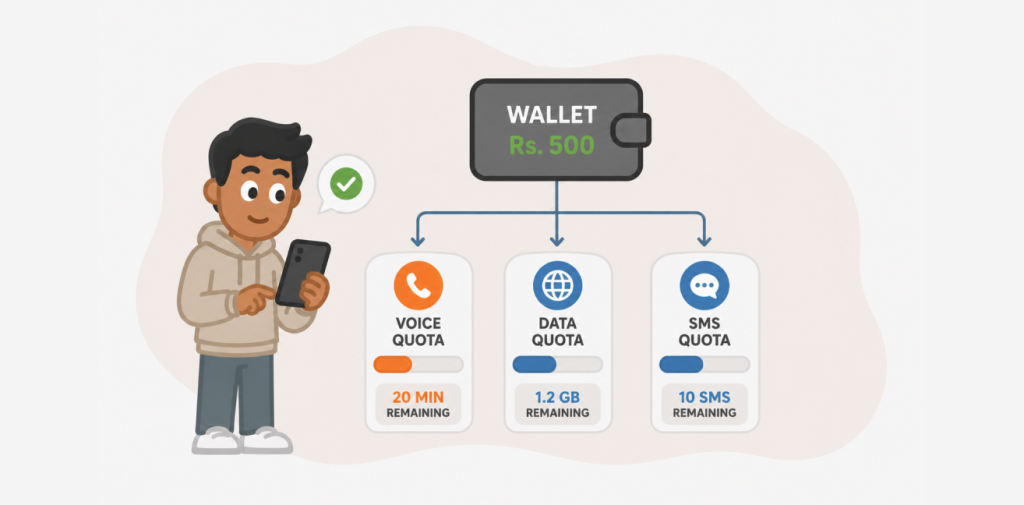
A subscriber may have PKR 100 in a cash balance. If the voice rate suggests that amount could cover a 30-minute call, the platform could theoretically reserve 30 minutes. But the same subscriber may also be using mobile data during the call, with both services drawing from the same prepaid balance. If the OCS gives too large a quota to the first session, the account can be over-allocated before the second service is rated.
The issue becomes more complex with shared wallets. A household account may have one prepaid balance used by several SIMs, with the account owner setting allowances or service caps for family members. If several users are calling, streaming, or browsing at the same time, they are all drawing from the same pool of credit. From a billing perspective, it does not matter whether they are in the same room or different cities, there is concurrent consumption against one balance.
The standard way to handle this is to grant smaller time or volume quotas and reauthorize frequently. Instead of allocating all available credit to one session, the OCS might authorize a few minutes of voice or a defined amount of data, then check the remaining balance again before granting more. That gives the platform enough control to keep balances accurate across simultaneous sessions without making the customer experience feel interrupted.
Balance buckets, shared wallets, and instant restore
In practice, prepaid charging usually runs through balance buckets. A subscriber may have a main cash balance, a data bucket, voice bucket, SMS bucket, promotional bucket, and a shared family wallet. Each bucket can have its own rules, validity dates, caps, and priority.
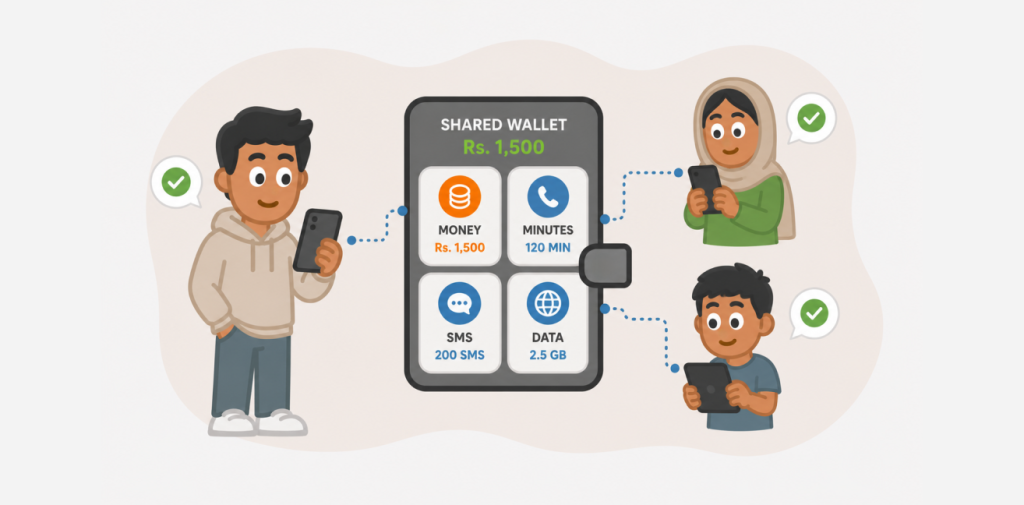
Each of these must be factored into product design. For example, a promotional data pack from a partner app should not drain the subscriber’s main cash balance, a child’s SIM on a family wallet may have a smaller data cap than the account owner, and a voice bundle may stay active after the data bucket is exhausted. These are not edge cases, they’re the everyday mechanics of prepaid service in a market where subscribers watch spend closely.
Threshold and restore logic are also key considerations. In simple terms, the threshold is the point at which the reserved quota or allowed balance has been reached. The OCS can then authorize another quota, apply a speed cap, redirect the user to top up, or stop the session. Once the subscriber recharges, service should restore immediately, without a support call or waiting period.
What low-ARPU prepaid launches usually teach
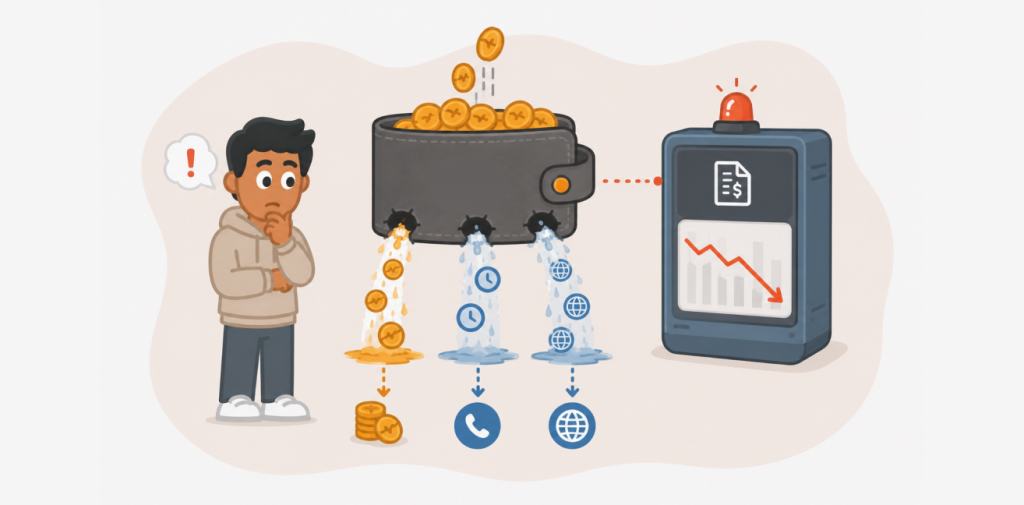
Pakistan is not the first market where a new operator has had to build a prepaid business around low ARPU from the first subscriber onward. A consistent set of lessons shows up across low-ARPU prepaid launches, regardless of region.
Automation is the margin lever. At PKR 306 ARPU, every manual transaction or support touch erodes margin. Rating, top-up, balance checks, bundle changes, notifications, and service restoration need to happen automatically.
Self-care is not optional. A mobile app matters for smartphone users, but USSD and agent-assisted workflows matter just as much where customers use feature phones, shared devices, or cash-based recharge.
Bundling is safer than a price war. A new MVNO rarely wins by undercutting incumbents indefinitely. It needs to package data, voice, promotions, community offers, and partner services quickly. A platform that takes weeks to configure a bundle slows down the only lever the product team can keep adjusting.
There are several viable business models. Some MVNOs pursue high-volume, low-margin segments such as mass-market data or IoT connectivity. Others serve a smaller niche willing to pay more for a specialized offer. Both require the same underlying discipline: accurate rating, low transaction overhead, and charging logic that scales without adding manual work.
Why real-time charging is a platform decision, not an add-on
Real-time charging is not a module to bolt onto an MVNO billing platform after launch. It touches the network side through online-charging interfaces, the product side through rating and bundle logic, the financial side through revenue assurance, and the subscriber side through balance visibility, top-up, and self-care. Retrofitting it later usually means rebuilding parts of these four areas.
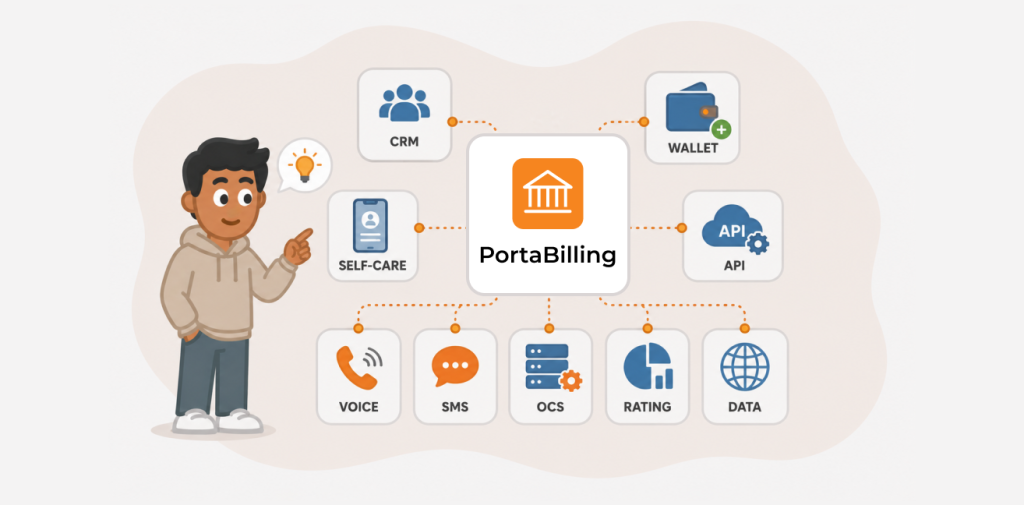
For a Pakistan MVNO, the launch-scope checklist is short but non-negotiable: a working OCS, configurable quota policies, support for shared wallets and balance buckets, top-up channels people actually use, self-care by default, fast bundle and promotion management, and revenue assurance built in from the start.
The PTA deadline and prepaid economics makes the decision both urgent and unavoidable. A prepaid-led subscriber base needs an MVNO billing system that gets the balance right, in the moment, every time, from the first day of commercial launch.
If you are preparing an MVNO license application, or you already hold one and are scoping your BSS and OCS requirements, talk to PortaOne. We can walk through what a real-time charging setup would look like for your launch timeline, recharge model, product catalog, and network integration requirements.