
Short answer: Price each model as your cost plus a fixed amount, because a percentage markup loses margin in proportion to every cost cut. PortaAIM can record your cost per model, let a plan price it as that cost plus a fixed fee, and show revenue, cost, and margin per session.
A percentage markup is a margin that shrinks every time you make serving a token cheaper.
The arithmetic is short. A markup is a fixed share of your cost. Cut the cost per million tokens by a quarter and the margin falls by exactly a quarter too. The share you picked doesn’t change that, only how much there was to lose.
You probably feel this already. Maybe you rent out GPU hours and now sell tokens on model endpoints beside them. Maybe you route requests to other people’s models and resell what they serve. Either way, what a token costs you sits in one place, a GPU bill or a provider’s price list, and what it earns sits in a rate card set once and checked rarely. The two meet, if they meet at all, in a spreadsheet at month end.
The fix is not a bigger percentage. It is a margin set as an amount, on top of a cost your billing actually holds, and changed only when you decide to change it.
One cost drop, three bills
Take one illustrative token endpoint that serves 300 billion tokens a month. Serving a million tokens costs you $0.80, and with a 20% markup you sell them for $0.96. You keep $0.16 per million tokens, which comes to $48,000 a month.
Then your team does its job. Newer GPUs, a better serving stack, a cheaper rental, or an upstream price cut bring the cost down to $0.60 per million tokens. That is a fall of 25%, while volume stays put.
You can bill the next month three ways: the same 20% markup, the new cost plus your old $0.16 markup, or keep charging the old price.
| Before the drop | 20% markup, repriced | Cost + $0.16, repriced | Price held | |
|---|---|---|---|---|
| Cost per million tokens | $0.80 | $0.60 | $0.60 | $0.60 |
| Price per million tokens | $0.96 | $0.72 | $0.76 | $0.96 |
| Margin per million tokens | $0.16 | $0.12 | $0.16 | $0.36 |
| Margin per month at 300 billion tokens | $48,000 | $36,000 | $48,000 | $108,000 |
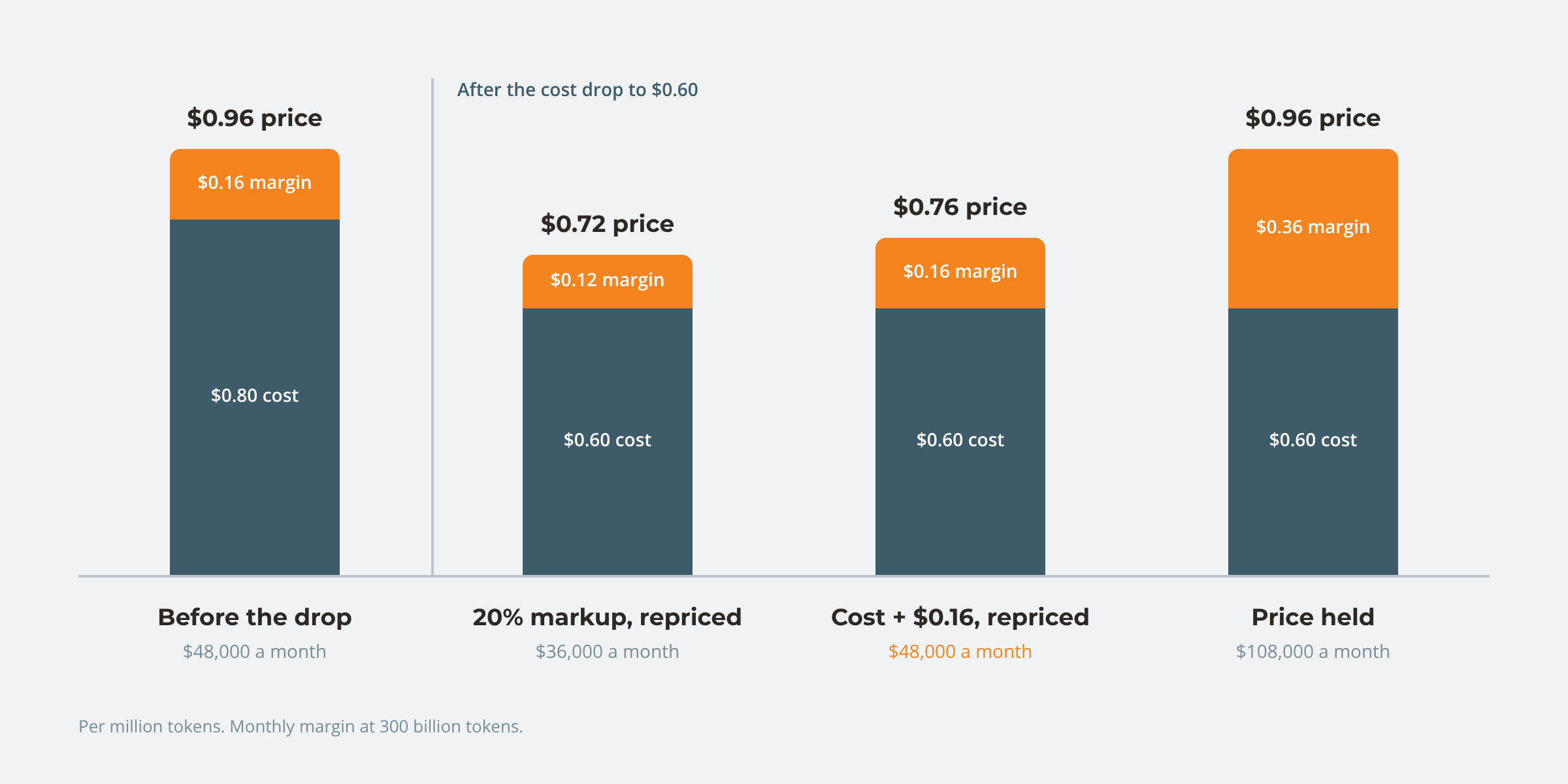
The markup column is the one a percentage picks for you. It pays $36,000, so getting better at serving tokens cost you $12,000 a month, or $144,000 a year.
The fixed amount still passes the savings on. Your customer pays $0.20 less per million tokens, and you keep $48,000 a month.
A percentage feels safe because it scales with cost. That is the trouble with it. It scales down just as readily, and passes on the whole savings plus a share of your margin.
The last column, $108,000 a month, is a choice, not a trick of the table. We’ll come back to who gets to make it.
Put your cost next to your price
None of these columns can be held on purpose unless your billing knows the $0.60. Right now that number probably turns up weeks after the tokens were sold, and your rate card never hears about it.
In PortaAIM, a token service can record its vendor cost, meaning what delivering it costs you, per unit. You set a default cost for the service and can override it for single items, so each model under one token service can carry its own cost and price. Tokens resold from a model provider can record their cost this way, and so can GPU compute resold by the compute-hour.
The prices themselves belong to the plan, not the service, so an enterprise plan and a self-serve plan can sell the same model at different amounts. So the cost arrives once, lands on the model it belongs to, and sits beside the price you sell that model for.
Type the fee once
Typing $0.76 into a rate card works exactly once. The next time the cost moves, someone has to redo the subtraction, and until they do, the margin drifts.
In PortaAIM, a plan can skip the typed price and set it as vendor cost plus a fixed fee, so you enter only the amount you add on top. That works on a whole service or on one model’s item override. Enter $0.16 there and you have the Cost + $0.16 column of the table.
Cost-plus pricing isn’t new, and we don’t pretend otherwise. What decides whether it holds your margin is where the cost comes from, a figure your billing holds per model, not one copied over from last quarter’s invoices.
You set prices per billing unit, such as a million tokens, and usage converts into it through a ratio fixed once the service exists. The count itself is exact. A 500-token request is billed for exactly 500 tokens, not rounded up to the next million. Even the smallest call pays its share of the $0.16.
Who decides when the price moves
Look at the three columns after the drop again. They aren’t three things a cost drop does to you. They’re three decisions, and the real question is who makes them.
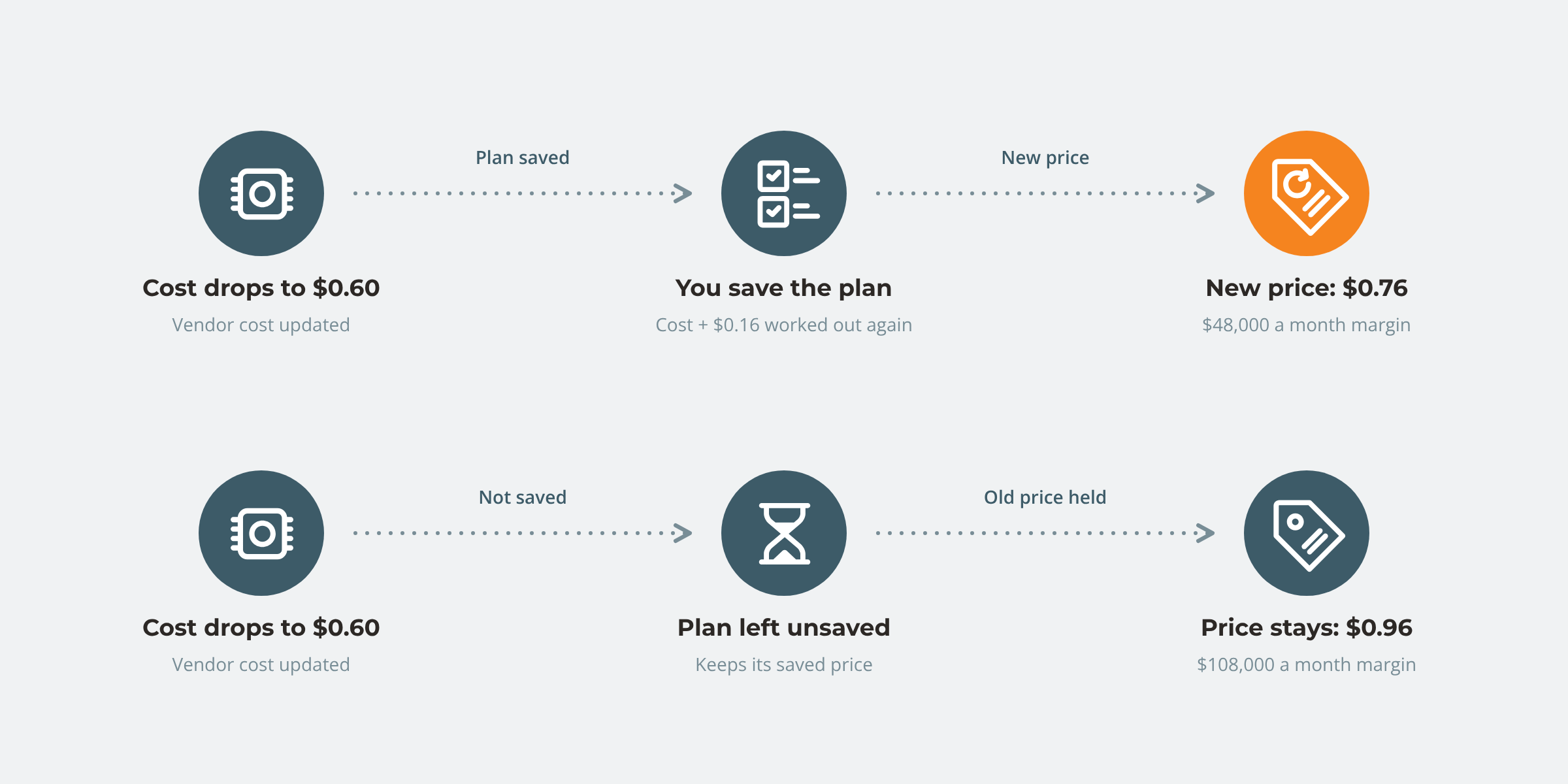
In PortaAIM, a cost-plus price is worked out when you save the plan. If you update the vendor cost later, the plan keeps charging the old price until you save it again. Repricing is a separate step you take.
So when the $0.60 lands, the next move is yours. Save the plan and the price becomes $0.76, with your $48,000 a month intact. Leave it unsaved and the price stays at $0.96, worth $108,000 a month, until you decide otherwise.
We think both are fair calls.
Check the margin one session at a time
A margin you set on the plan still needs checking, and a monthly total can’t tell you which conversations or jobs earned it.
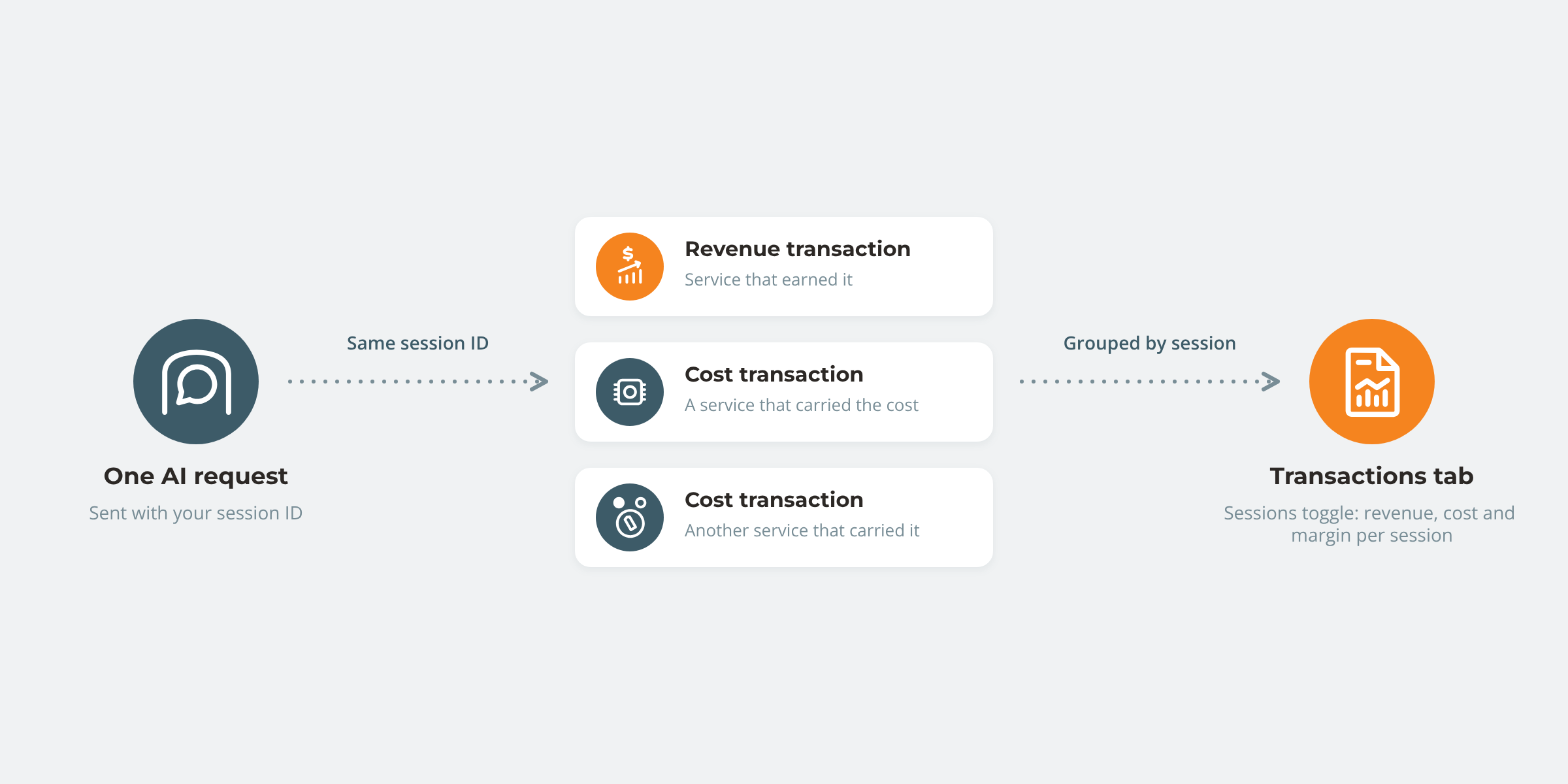
Your integration sends its own session ID with each charge, a label you choose for related usage such as one chat conversation or one batch job. One AI request can then bill several transactions under that ID: one on the service that earned the revenue and others on the services that carried the cost.
Each customer’s Transactions tab shows revenue, cost, and margin, and the Sessions toggle groups them by session, every transaction sent with one session ID together, so you see what each piece of work actually earned.
The endpoint in our table got cheaper to run and lost nothing for it. Somewhere on your team, someone is already chasing the next cost cut. Under a percentage, their win lands on your margin as a loss. Under a fee on a recorded cost, it lands as a plan waiting to be saved, and when you save it is your call.
Ask for a quote on your own numbers
Sources: our product documentation, read 9 November 2026 and 16 November 2026.
FAQ
Keep your cost and your price in the same system, then tie the price to the cost by a set amount. PortaAIM can record the vendor cost per unit on a token service and override it for any model listed as an item. A plan can then price the service or a single model as that cost plus a fixed fee.
PortaAIM can hold every provider’s models as items under your token services, each with its own recorded cost and its own price. At the end of each customer’s billing period, it automatically generates one invoice for that customer, itemizing usage charges by service.
In PortaAIM, each model’s cost can sit next to its plan price, and that price can be set as the cost plus a fixed fee instead of a typed figure. Usage is charged at its true token count rather than rounded up to a whole billing unit.
A percentage markup falls by the same share as the cost beneath it, so price each model as its cost plus a fixed amount. In PortaAIM, a plan can set that price as the recorded vendor cost plus a fixed fee. After a cost change, the plan keeps charging the price it was saved with until you save again. With the Sessions toggle, each customer’s Transactions tab groups revenue, cost, and margin by the session ID you send.
PortaAIM prices usage that arrives late at the rate in force when it happened, provided the event carries that time. The time can be at most 90 days old and cannot lie in the future. An event outside that window is refused before anything is billed.